
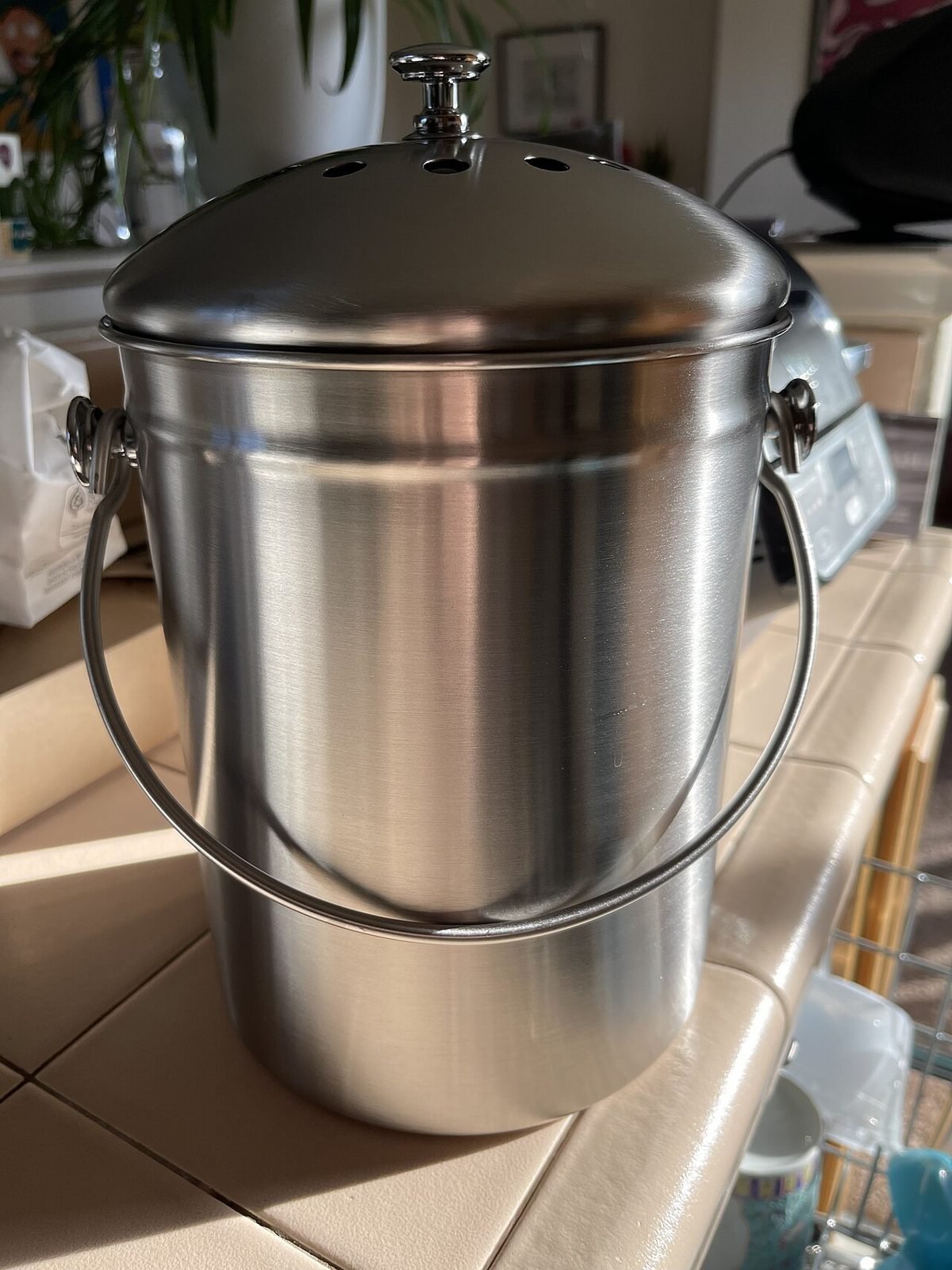
You don’t need a backyard to keep food scraps out of the trash. You do need to pick the right method for your space, your building and what you actually throw away. A worm bin that’s perfect for vegetable peelings will struggle with leftover chicken. A countertop gadget that shrinks your scraps doesn’t, by itself, make compost.
This guide compares four apartment-friendly options: worm bins, bokashi, countertop units and drop-off or collection programs. For each, we cover what it can and can’t take. Then we look at the “compostable” label, which often means something narrower than it sounds.
First, what counts as composting
The US EPA defines composting as the managed, aerobic (oxygen-required) biological decomposition of organic materials by microorganisms. The result is compost, a stable soil amendment. (US EPA, Composting at Home)
For people without a yard, the EPA lists vermicomposting (worm composting) as a home option, and suggests that if you don’t have space, you join a local municipal or community composting program, which may collect your food scraps or offer a place to drop them off. (US EPA)
Option 1: a worm bin (vermicomposting)
Best for: fruit and vegetable scraps, coffee grounds, small households with a closet, balcony or under-sink space.
The EPA says worm composting takes up little space, the materials are simple and inexpensive, and it can be done indoors or outdoors. A properly maintained bin should not emit odors or attract pests. (US EPA)
What you need, per the EPA:
- A bin with a tight-fitting lid, in a dark color to keep light out. You can make one from two plastic storage bins, one with air and drainage holes nested inside the other to catch liquid.
- The right worms. The EPA says only a handful of earthworm species suit vermicomposting; one of the most used is the red wriggler (Eisenia fetida). Don’t use worms from the garden or a bait shop. It suggests starting with about one pound of worms, roughly 1,000.
- Bedding: shredded non-glossy newspaper, office paper, cardboard or dry leaves, soaked and wrung out like a moist sponge, plus a handful of soil.
- A comfortable spot. The EPA suggests keeping the bin at 59° to 77°F (about 15° to 25°C). On a balcony, insulate it in cold months.
What worms can take: most fruit and vegetable scraps, coffee grounds and paper filters, paper tea bags without staples, and crushed eggshells.
What to keep out: the EPA says to avoid citrus, onions and garlic, meat, dairy, greasy foods, bones and pet waste. Chop scraps small, bury each feeding under about two inches of bedding, and make sure the last batch is eaten before adding more. (US EPA)
What you get: the EPA says you can harvest vermicompost (worm castings) after three to six months, and it doesn’t need to cure. Use it on houseplants, window boxes or balcony pots, or give it to a friend with a garden.
Option 2: bokashi (fermentation)
Best for: households that throw away cooked food, meat or dairy, and have somewhere to finish the result.
A bokashi kit is usually an airtight bucket plus a bran that carries the fermenting microbes. You layer scraps and bran and keep the lid shut. Washington State University Extension says bokashi lets you compost almost all types of food waste, including fruit and vegetable scraps, cooked food, dairy, meat, and even small bones. (WSU Extension)
Two things to know before you buy a bucket:
- It’s fermentation, not finished compost. WSU Extension says the microbes ferment the food waste rather than allowing it to rot, and that bokashi is an anaerobic process. The result is not finished compost. (WSU Extension) Compare that with the EPA’s definition above, which requires oxygen.
- You need a second step. Fermented scraps still have to break down somewhere. WSU says that after fermentation you bury the material in a garden bed or mix it into a traditional compost pile. (WSU Extension) In an apartment, that usually means a large planter, a community garden plot, a friend’s garden, or a drop-off program that accepts it. Check that last one first.
A bokashi system is two buckets and a bag of bran. The finished ferment still needs soil or a compost program to finish breaking down.
Option 3: countertop “composters”
Best for: cutting the smell and volume of scraps before they go somewhere else.
These are electric appliances that grind and dry food scraps. The EPA is direct about what they do: residential pre-processing appliances reduce the volume and weight of food scraps by grinding and dehydrating them, but they do not produce compost. What comes out is a dried food-scrap mixture that can be added to a composting system, at home or through a collection program. (US EPA)
So if a countertop unit is marketed as turning scraps into “compost” or “fertilizer” overnight, read that as the brand’s claim. The output can be useful; it’s just not finished compost by the EPA’s definition. Before you buy one, ask:
- Where will the output go? Your planters, a worm bin, or a collection program? Does your local program accept it?
- How much power does it use per cycle, and how often will you run it? The brand should publish this.
- What does it take? Check the manual’s list of items to keep out.
- What filters or parts need replacing, and what do they cost?
Option 4: drop-off and curbside collection
Best for: almost everything a home system can’t take, if your local program accepts it.
Many cities, counties and councils run food-scrap collection or drop-off sites. Chicago, for example, has added drop-off sites at public libraries. (WTTW News) The EPA points people without space toward a local municipal or community composting program. (US EPA)
Programs that send scraps to a larger composting operation may accept more than a home bin can handle. The EPA notes that meat, fish, bones, dairy, fats and oils, and compostable food-service ware and bags can be composted at commercial composting facilities, but says to check first that your specific facility accepts them. (US EPA)
To find a program, search your city, county or council website for “food scraps” or “organics”, and read its accepted-items list. Rules differ a lot from place to place.
What each method can take, at a glance
| Worm bin | Bokashi | Countertop unit | Drop-off / collection | |
|---|---|---|---|---|
| Fruit and veg scraps | Yes | Yes | Check manual | Check local list |
| Citrus, onion, garlic | Avoid (EPA) | Check your kit’s guide | Check manual | Check local list |
| Meat, fish, dairy | No (EPA) | Yes (WSU) | Check manual | Check local list |
| Small bones | No (EPA) | Small ones (WSU) | Check manual | Check local list |
| “Compostable” bags and cups | No | No | No | Only if the program says so |
| Makes finished compost? | Yes | No, needs a second step | No (EPA) | Yes, off-site |
The “compostable” label: read the conditions
This is where good intentions go wrong. Many products labeled “compostable” are designed to break down in commercial (industrial) composting facilities, which run hotter and are more tightly managed than a home bin.
- Home piles don’t get hot enough for many of them. The EPA lists compostable food-service ware and compostable bags among the things to keep out of a backyard pile, because backyard piles generally do not reach high enough temperatures to fully decompose these materials. (US EPA) A worm bin or bokashi bucket is not a better bet.
- The FTC expects sellers to say so. The FTC Green Guides say it’s deceptive to misrepresent that a product is compostable, and that a marketer should clearly and prominently qualify compostable claims if composting facilities aren’t available to a substantial majority of consumers where the item is sold. (16 CFR 260.7)
- Certification labels tell you which kind. In the US, the Biodegradable Products Institute (BPI) certifies compostable products and distinguishes items certified for commercial compost facilities only from those certified for home composting too. (BPI) Read the label for which one applies.
- Even certified items aren’t accepted everywhere. Check your local program’s list before you buy compostable bags or tableware for it.
For more on what “compostable” and “biodegradable” mean on a label, including the Australian standards, see what “biodegradable” and “carbon neutral” really mean.
Choosing your setup
- Mostly produce scraps, a little space, happy to keep a pet bin: a worm bin.
- Lots of cooked food or meat, and somewhere to bury or drop off the result: bokashi.
- A good local collection program: a lidded caddy and the program may be all you need. A countertop unit can cut smell and volume between pickups, if the program accepts its output.
- No program and no space: start with a small worm bin for produce scraps, and ask your city or council whether a drop-off site is planned.
Browse worm composting bins on Amazon (US)
Browse bokashi bucket kits on Amazon (US)
For the worms themselves, the EPA suggests buying from a worm grower or asking a neighbor who already has a bin.
How we picked
- We compared methods using the US EPA’s home composting guidance, plus university extension guidance on bokashi, linked where used.
- We link searches rather than single products because we haven’t verified specific bins or kits. Look for a tight-fitting lid and clear instructions.
- We haven’t tested any composting products.
- We quote brands’ “compost” and “compostable” claims as theirs, and say what conditions apply. See how we judge green claims.
Sources
- US EPA, Composting At Home: epa.gov
- Washington State University Extension (Kitsap County), Bokashi Composting: extension.wsu.edu
- FTC Green Guides, 16 CFR 260.7 (compostable claims): law.cornell.edu
- Biodegradable Products Institute, Certification: bpiworld.org