
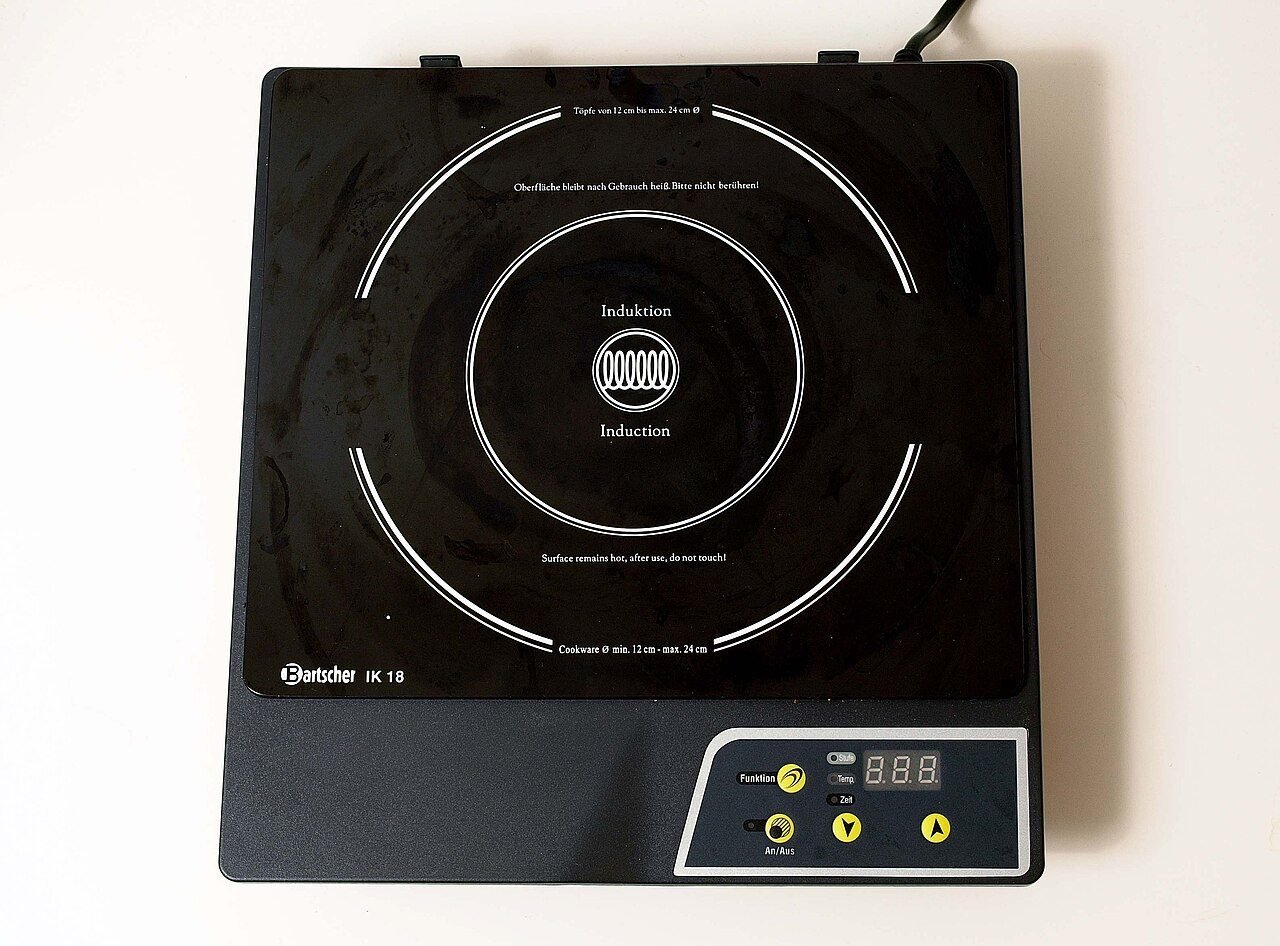
If you rent, you probably don’t get to choose your stove. But you can choose what sits on the counter. A plug-in (portable) induction hob is a single burner, or sometimes two, that plugs into a wall outlet. You can use it alongside the stove you have, take it with you when you move, and find out whether you like induction before you ever have a say in a kitchen remodel.
The US Department of Energy suggests exactly this: if you’re a renter, or you want to try induction before swapping out your entire cooktop, consider a single-burner induction appliance. (US DOE)
This guide covers how induction works, how to check your cookware in ten seconds, what the energy agencies say about efficiency, and what to look for in a plug-in unit.
How induction works
A gas burner heats the pan with a flame. A standard electric cooktop heats an element or glass surface, which then heats the pan. Induction heats the pan itself.
The DOE explains that induction uses an electromagnetic field that transfers currents directly to the cookware, so the heat is created inside the pan. As soon as you remove the pan, the heating stops. (US DOE) ENERGY STAR describes the same thing: induction uses electromagnetic energy to heat ferromagnetic cookware internally. (ENERGY STAR)
Because the glass top isn’t the heat source, ENERGY STAR says the surface won’t be hot to the touch without a pot or pan in place. A pan that’s just come off the heat will still warm the glass where it sat. (ENERGY STAR)
The magnet test
Induction only works with cookware a magnet sticks to. You don’t need to buy anything to find out what you already own:
- Take a fridge magnet to your pans.
- Hold it to the bottom of each pan. If it sticks firmly, the pan should work. ENERGY STAR: if the magnet sticks, it will work with induction. (ENERGY STAR)
- Check the base is flat. The DOE says pots or pans with a flat bottom that a magnet sticks to will work. (US DOE) A warped pan may not sit well on the glass.
- If the magnet doesn’t stick, or only barely, assume that pan won’t work on induction.
ENERGY STAR notes that a lot of common cookware may already be compatible, such as cast iron, stainless steel and enameled cast iron, and that many induction-compatible pots and pans have an induction logo on the box. (ENERGY STAR) ENERGY STAR suggests the magnet test precisely if you’re unsure what your cookware is made of.
If you need one new pan, start with the size you use most. One good pan you’ll keep for years beats a matching set that duplicates what you own.
The energy facts
Here is what US energy agencies say, in their words.
Efficiency
- About 85% vs about a third. ENERGY STAR says that with induction, about 85% of heating energy is transferred to what’s in the cookware, compared with only about a third with gas cooking products. (ENERGY STAR)
- Compared with other electric cooktops. ENERGY STAR’s Emerging Technology Award page puts conventional gas and resistance-element cooking tops at about 32% and 75–80% efficiency respectively, and induction at about 85%. (ENERGY STAR)
- The DOE’s summary: induction appliances are up to three times more efficient than gas stoves, and up to 10% more efficient than conventional smooth-top electric ranges. (US DOE)
What that means for a renter’s bill depends on how much you cook, your electricity and gas rates, and what you’d otherwise use. A single plug-in burner used for the evening meal won’t transform a power bill. The DOE says the efficiency can result in lower energy costs, which is a fair way to put it. (US DOE)
Speed
ENERGY STAR says boiling water with induction can take nearly half the time compared with gas, radiant or coil cooktops. (ENERGY STAR) The DOE cites Consumer Reports’ finding that induction cooktops can boil water 20–40% faster than the gas and traditional electric cooktops it tested. (US DOE) The two figures come from different tests; either way, induction is quick.
A cooler kitchen
ENERGY STAR says more of induction’s energy goes into cooking and less heat is released into the kitchen, which can help keep the room cooler. (ENERGY STAR)
Where the “green” part comes from
The efficiency gain is real and measurable. The wider climate effect depends on where your electricity comes from. The DOE says the efficiency can lead to lower rates of air pollution associated with energy generation. (US DOE) If your power comes from a cleaner grid or a renewable electricity plan you can verify, the benefit grows. We don’t call any appliance “eco-friendly” without saying why; see how we judge green claims.
Choosing a plug-in induction hob
ENERGY STAR
ENERGY STAR now certifies electric cooking products, and its criteria include standalone/portable cooktops as well as ranges. ENERGY STAR says certified electric cooking products are 18% more efficient on average than standard models. (ENERGY STAR) Its online Product Finder lets you check whether a specific model is certified. Partners sometimes offer rebates on certified products, which you can look up with ENERGY STAR’s Rebate Finder.
What to check on the listing
- Wattage and plug. Check the hob’s rated wattage on the label and make sure your outlet and plug type match the model sold in your country.
- Your circuit. A plug-in hob on high draws a lot of power. Don’t run it on the same circuit as a kettle, microwave, toaster oven or space heater at the same time, and follow the manual’s instructions on extension cords and power strips. If a breaker trips, stop and ask your landlord.
- Safety listing. Look for a recognized safety certification mark for your country (in the US, a nationally recognized testing lab such as UL or ETL).
- Auto shut-off and pan detection. The DOE says most induction cooktops automatically shut off if a pot or pan isn’t detected. (US DOE) Check the specific model.
- Coil size vs your pans. A large pan on a small coil heats unevenly. The listing should give the heating zone or coil diameter.
- Controls and noise. Check how settings are shown (power levels or temperatures), whether there’s a timer, and what owners say about fan noise.
Renter checklist
- [ ] Check your lease for any rules about cooking appliances.
- [ ] Do the magnet test on your pans first.
- [ ] Find an outlet on a circuit that isn’t shared with other high-draw appliances.
- [ ] Give the hob a stable, heat-safe surface with space around its vents.
- [ ] Keep the manual and receipt; you’ll take the hob with you when you move.
Living with it
- Protect the glass. ENERGY STAR notes most electric and induction cooking tops are glass or ceramic and vulnerable to scratches and cracking. Don’t drag heavy cast iron across it, and skip scouring sponges; soapy water on a cooled top is usually enough. (ENERGY STAR)
- Plastic utensils. ENERGY STAR says melting plastic utensils is less of a concern with induction, because it doesn’t produce significant residual surface heat. The pan itself still gets hot.
- Expect a learning curve. Induction responds quickly. Start a notch lower than you would on gas or coil.
Browse portable induction hobs on Amazon (US). Check each listing for a safety certification, the rated wattage and the coil size.
Shopping during the sales? Our Black Friday green deals guide has a framework for deciding whether a discount is worth it.
How we wrote this
- The energy figures come from ENERGY STAR and the US Department of Energy, quoted and linked where used. Where two sources give different figures, we show both.
- We link a search rather than one model because we haven’t verified current certification and specs for individual plug-in hobs. Use ENERGY STAR’s Product Finder to check a model.
- We haven’t tested any induction hobs.
- This article is about energy and practicality. We don’t make health claims about any type of stove.
Sources
- ENERGY STAR, Electric Cooking Products: energystar.gov
- ENERGY STAR, 2021–2022 Residential Induction Cooking Tops (Emerging Technology Award): energystar.gov
- US Department of Energy, Making the Switch to Induction Stoves or Cooktops (May 2023): energy.gov