
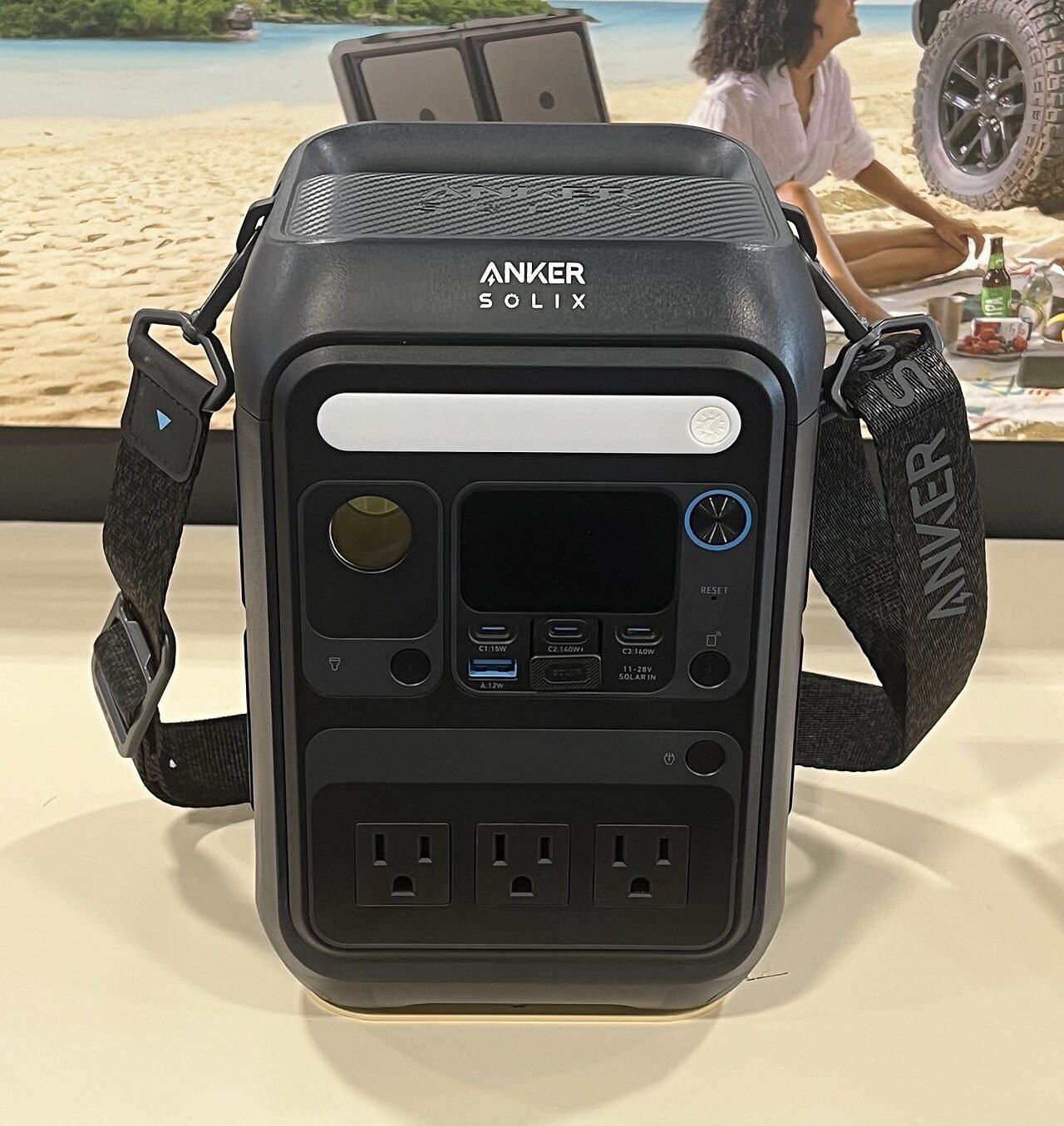
A portable power station’s spec sheet can run to dozens of lines, and most of them don’t matter for most buyers. A handful decide whether the unit will run what you need, for how long, and for how many years.
This guide goes through a spec sheet in the order we read one. It doesn’t rank brands, and any product figure we quote is the brand’s rating, not our measurement.
1. Capacity: watt-hours (Wh)
Watt-hours measure how much energy is stored. It’s the size of the tank. A 1,000 Wh station holds roughly ten times the energy of a 100 Wh power bank.
Some sheets give amp-hours (Ah) or milliamp-hours instead, which don’t tell you the energy without the voltage. The FAA gives the conversion: to calculate Wh, multiply the battery voltage by the amp-hours. (FAA PackSafe) If a sheet lists only mAh, look for the cell or pack voltage, or skip to a model that states Wh plainly.
Usable vs nameplate capacity
The Wh on the box is the battery’s rated capacity. You won’t get all of it out as 230 V or 120 V AC, because the inverter that turns battery power into household current loses some energy as heat. How much varies by model and by load, so don’t assume a figure; if the brand publishes an efficiency or “usable capacity” number, use that. Otherwise, build in some headroom when you size a unit.
A rough planning sum: runtime (hours) ≈ usable Wh ÷ device watts. We show a worked example with a planning allowance in our EcoFlow vs Jackery comparison.
2. Output: watts (W) and surge watts
Rated (continuous) output, in watts, is how much power the station can deliver at once, indefinitely. It decides what you can run, not how long. A big battery with a small inverter still can’t run a kettle that needs more than the inverter’s rating.
Surge (or peak) watts is a short burst above the continuous rating. Motors and compressors, such as those in fridges, pumps and some tools, can draw more for a moment when they start than they do while running. If your device starts and immediately trips the station, surge is the line to check.
What to look for:
- Your device’s label wattage should sit comfortably under the continuous rating.
- Check how the brand defines surge (for how long it lasts), and treat it as a rough guide.
- AC outlet count and type vary between US and Australian versions of the same model. Check the regional spec sheet.
3. Battery chemistry: LiFePO4 (LFP) vs NMC
Most current power stations use one of two lithium-ion chemistries:
- LiFePO4, also written LFP (lithium iron phosphate).
- NMC (lithium nickel manganese cobalt oxide), common in older and lighter units.
Sellers of LFP units pitch it on cycle life. Jackery, for example, says on its own blog that LFP batteries offer 3,000 to 6,000+ charge cycles, compared with 500 to 2,000 for NMC. (Jackery) Treat that as a brand’s general claim, not a guarantee for any one product, and remember that ranges like these depend on the test conditions. Rather than relying on the chemistry name, compare the two numbers that follow from it: the rated cycle life (with its endpoint) and the weight per Wh. Divide weight by capacity to see how much you’re carrying per unit of storage.
Whichever chemistry it uses, a lithium battery needs care. The FAA notes that all lithium-ion batteries are capable of overheating and undergoing thermal runaway, which can be triggered by damage, overheating, water exposure, overcharging or a manufacturing defect. (FAA PackSafe) Follow the manufacturer’s charging and temperature instructions, and stop using a unit that is swollen, damaged or hot to the touch when idle.
4. Cycle ratings, and why the endpoint matters
A cycle rating tells you how many full charge-and-discharge cycles the battery is rated for before its capacity falls to a stated percentage of the original. That percentage is the endpoint, and it changes what the headline number means.
For example, EcoFlow’s user manual for the DELTA 2 gives a cycle life of 3000 cycles to 80%+ capacity. (EcoFlow DELTA 2 user manual, PDF) Another brand might rate a model to 70% remaining capacity instead. Those two ratings aren’t directly comparable: a battery rated to a lower endpoint can quote a bigger cycle count for the same wear.
How to read a cycle line:
- Find the endpoint. “3,000 cycles” means little without “to 80%” or “to 70%”. If the sheet doesn’t say, ask the brand or treat the number as marketing.
- Compare like with like. Only compare cycle counts that share the same endpoint.
- Translate it into your use. A unit cycled once a month will take a very long time to use up thousands of cycles. For occasional backup, warranty length and repair support may matter more than the cycle count.
- Check the warranty separately. The cycle rating is a design figure; the warranty is what the brand will actually stand behind.
5. Certifications: UL 2743 and what it covers
In North America, the safety standard to look for on a portable power station is UL 2743, the Standard for Portable Power Packs. UL Solutions describes portable power packs as batteries intended for use when normal grid power isn’t available, such as camping or emergencies, charged from an external source and supplying power through outlets such as AC receptacles, USB, DC jacks and vehicle sockets. (UL Solutions)
Three practical points from UL Solutions’ guidance:
- Check who certified it. A listing can come from UL Solutions or from another recognized certification body. The mark should name the standard and the certifier, and you should be able to look the listing up.
- UL 2743 has a size ceiling. UL Solutions says the scope of UL 2743 limits the aggregate capacity for lithium-ion batteries to 20 kWh; a bigger product must be certified to UL 9540 instead.
- A portable power pack isn’t a home battery system. UL Solutions says the correct certification for a stationary battery energy storage system in a home is UL 9540, and that combining individually certified products in the field doesn’t create a certified system. If you plan to wire a power station into your home’s circuits, talk to a licensed electrician about what your local code requires before you buy.
Outside North America, look for the marks your country recognizes.
6. Flying with a power station: the 100 Wh and 160 Wh lines
This is where capacity becomes a rule, not a preference. In the US, the FAA sets these limits for passengers:
- Up to 100 Wh: spare lithium-ion batteries, including power banks, are allowed, but only in carry-on baggage. (FAA PackSafe) The TSA confirms power banks are prohibited in checked bags. (TSA)
- 101 to 160 Wh: with airline approval, a passenger may carry up to two of these larger spares. (FAA PackSafe)
- Over 160 Wh: not allowed in carry-on or checked baggage. (FAA PackSafe)
A typical “home backup” power station is rated well above 160 Wh (the 1 kWh class models in our comparison are around 1,000 Wh), so it can’t fly with you. If you want something you can take on a plane, look for a unit or power bank rated at 100 Wh or less, with the Wh figure printed on it. The FAA also says many airlines set stricter limits, including on how many power banks you can bring, so check your airline before you pack. Outside the US, check your airline and your country’s aviation regulator.
7. The rest of the sheet, quickly
- AC charging input (W) and solar input (W and voltage range): these decide how fast you can refill. Check that any solar panel you plan to use falls within the stated voltage range, not just the wattage.
- Pass-through charging / UPS mode: whether the station can power devices while it charges, and how quickly it switches over in an outage. If you’re relying on it for a modem or a medical device, read the brand’s exact wording on switch-over time and ask the brand before you rely on it.
- Operating and charging temperature ranges: if you camp in the cold or store the unit in a hot garage, check both ranges, and follow them.
- Expandability: some models accept add-on batteries; others can’t be expanded at all.
- Warranty and repair: length, what it covers, and whether parts and service are available where you live.
A one-page checklist
- [ ] List the devices you’ll run and their wattages.
- [ ] Continuous output comfortably above your biggest device; surge enough for anything with a motor.
- [ ] Capacity (Wh) that covers your runtime, with headroom for inverter losses.
- [ ] Cycle rating with its endpoint, compared only to ratings with the same endpoint.
- [ ] A safety certification you can look up (UL 2743 in North America).
- [ ] If you’ll fly with it: 100 Wh or less without airline approval; never over 160 Wh.
- [ ] Charging inputs that fit how you’ll recharge (wall, car, solar).
Browse LiFePO4 portable power stations on Amazon (US). Check each listing’s spec sheet against the checklist above.
If you’re shopping during the sales, our Black Friday green deals guide has a framework for deciding whether a discount is worth it.
How we wrote this
- We based the rules sections on the FAA, the TSA and UL Solutions, and linked each one where it’s used.
- We used two brand statements, each attributed and linked, and one real product figure as a brand rating reported by a named independent source, to illustrate cycle endpoints. We didn’t test any units.
- We don’t name a “best” power station here, because the right one depends on what you need to run. Our EcoFlow vs Jackery comparison applies this checklist to two popular models.
- No brand paid for placement. A power station stores energy rather than making it, so we weight longevity (cycle endpoints, warranty, repair) heavily; see how we judge green claims.
Sources
- FAA, PackSafe: Lithium Batteries: faa.gov
- FAA, PackSafe: Portable Recreational Vehicles Powered by Lithium Ion Batteries: faa.gov
- TSA, What Can I Bring? Power Banks: tsa.gov
- UL Solutions, Q&A: Portable Power Packs: ul.com
- EcoFlow, DELTA 2 user manual (PDF): websiteoss.ecoflow.com