
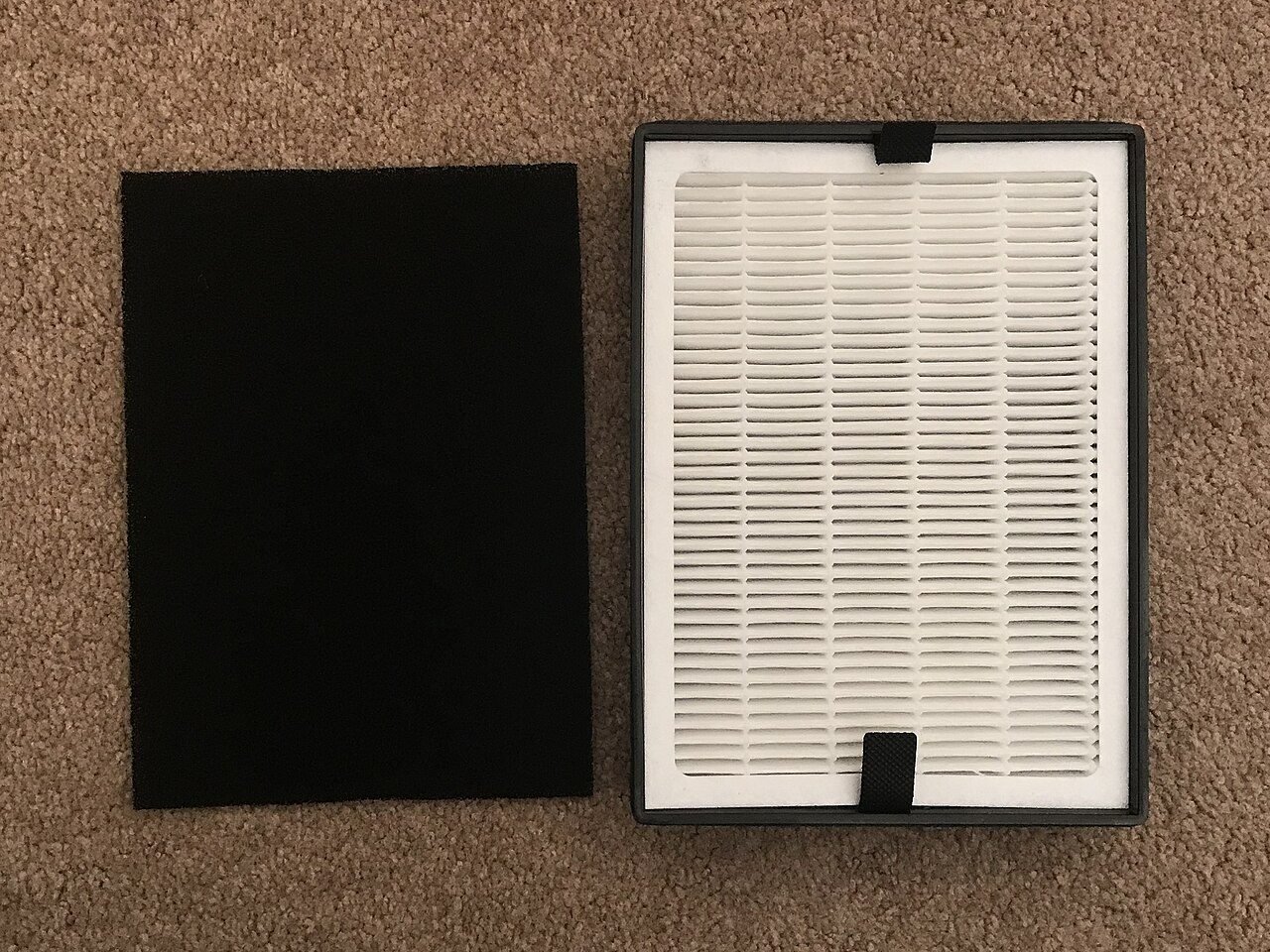
Air purifier boxes are crowded with filter words: “HEPA”, “True HEPA”, “HEPA-type”, “HEPA-like”, “99% HEPA”. Some of these mean something specific. Others are there to borrow a respected name.
Here’s the short version: “HEPA” has a definition; “HEPA-type” doesn’t. But even a true HEPA filter tells you about the filter, not the machine. To know how well a purifier cleans a room, the number to check is the CADR.
What HEPA actually means
HEPA stands for high-efficiency particulate air. The US EPA describes it as a type of pleated mechanical air filter, as officially defined by the US Department of Energy, that can theoretically remove at least 99.97% of dust, pollen, mold, bacteria and other airborne particles with a size of 0.3 microns. (US EPA, What is a HEPA filter?)
Why 0.3 microns? The EPA explains that it’s the worst case, the most penetrating particle size. Particles larger or smaller than that are trapped with even higher efficiency. So the 0.3-micron figure is a floor, not a ceiling.
Two things that definition doesn’t tell you:
- How much air the machine moves through the filter. A perfect filter in a weak, slow machine cleans a room slowly.
- Whether air leaks around the filter. Air that bypasses the filter through gaps in the housing isn’t filtered at all. That’s a property of the whole machine, not the filter media.
What “HEPA-type” and “HEPA-like” mean
Nothing formal. Neither is part of the HEPA definition above, so they don’t promise HEPA-level efficiency.
HEPA claims have been challenged before. The FTC has taken action over them: in one case, a proposed agreement would prohibit a filter maker from misrepresenting that any air filter is a HEPA filter. (FTC)
Our rule of thumb: if the box says “HEPA-type”, “HEPA-like”, “HEPA-style” or “99% HEPA”, assume it isn’t HEPA. If the brand says it is, look for the filter’s stated efficiency at 0.3 microns and who tested it.
What about “True HEPA” and filter grades?
“True HEPA” is how brands signal that they mean the real thing rather than “HEPA-type”. Treat it like any other HEPA claim and look for the efficiency statement. The same goes for letter-and-number filter grades: look for the standard named alongside the grade and the lab that tested it. A grade with no test behind it is just a label.
Why CADR matters more than the filter label
A filter label describes the filter. CADR (clean air delivery rate) describes what the whole machine delivers to the room.
AHAM, the US appliance manufacturers’ association, explains that CADR indicates the volume of filtered air an air cleaner delivers, with separate scores for tobacco smoke, pollen and dust. The higher the number for each, the faster the unit filters the air. (AHAM Verifide)
CADR captures what a HEPA label leaves out: fan power, airflow, filter efficiency and leaks around the filter, all in one tested number. The EPA puts it this way: portable air cleaners often achieve a high CADR by using a HEPA filter. (US EPA, Guide to Air Cleaners in the Home) HEPA is one route to a good CADR; the CADR is the result.
Which CADR to read
The EPA explains that the three CADR scores use tobacco smoke, dust and pollen as stand-ins for small, medium and large particles. To remove small particles, choose a purifier with a high smoke CADR. (US EPA) Smoke CADR is the number to use for fine particles such as PM2.5 and wildfire or bushfire smoke.
Sizing: the two-thirds rule
AHAM’s rule of thumb is that the CADR should be at least two-thirds of the room’s area in square feet. Its example: a 10 × 12 ft room (120 sq ft) needs a smoke CADR of at least 80. For wildfire smoke, AHAM recommends a smoke CADR equal to the room’s area in square feet. If your ceilings are higher than 8 feet, size up. (AHAM Verifide)
| Room area | Minimum CADR (EPA chart, 8 ft ceilings) |
|---|---|
| 100 sq ft (about 9 m²) | 65 cfm |
| 200 sq ft (about 19 m²) | 130 cfm |
| 300 sq ft (about 28 m²) | 195 cfm |
| 400 sq ft (about 37 m²) | 260 cfm |
Source: US EPA, Guide to Air Cleaners in the Home. The EPA says the chart is for estimation only.
For more on sizing and a shortlist of models, see Best air purifiers for small apartments (and how CADR works).
Where to find a verified CADR
AHAM runs the AHAM Verifide program, and says to look for its mark, usually on the side or back of the packaging. (AHAM Verifide) A CADR claimed without that mark may be accurate, but you’re taking the brand’s word for it.
Note that CADR covers particles only. The EPA says the CADR rating system is for particles, and that there are no widely used performance ratings for filters designed to remove gases. (US EPA) For odors and VOCs, the EPA suggests an activated carbon or other filter designed for gases, and notes these work best with a large amount of material.
Other labels on the box
- ENERGY STAR: this is about energy use only. The EPA says the label does not refer to air-cleaning effectiveness in any way. (US EPA) It’s still worth having, because purifiers often run for long hours.
- Ionizers, “plasma”, UV: the EPA says air cleaners using electrostatic precipitators, ionizers, UV lights without adequate lamp coatings and plasma may have the potential to emit ozone, and advises avoiding air cleaners that intentionally produce ozone. Both the California Air Resources Board and AHAM keep lists of air cleaners tested to emit little or no ozone. (US EPA)
- “Ozone generator” sold as an air purifier: the EPA says no federal government agency has approved these devices for use in occupied spaces.
- MERV: a rating for furnace and HVAC filters, not portable purifiers. The EPA says MERV reports a filter’s ability to capture particles between 0.3 and 10 microns, and the higher the rating, the better it traps particles. (US EPA)
Replacement filters: the label matters here too
Replacement filters sold online vary a lot. AHAM warns that off-brand or unverified filters may look similar, but some may fail to meet the performance standards of the original, and it now runs a verification program for replacement filters. (AHAM Verifide) When you price a purifier, price its filters too, and check whether the replacements you plan to buy are the maker’s own or independently verified.
The EPA’s advice applies whichever filter you use: all filters need regular replacement, and a dirty, overloaded filter won’t work well. (US EPA)
A two-minute label check
- Find the smoke CADR. No CADR? Move on, unless the brand publishes test data you can check.
- Look for the AHAM Verifide mark.
- Check the room size. Smoke CADR at least two-thirds of your floor area in square feet (or equal to it for wildfire smoke, per AHAM).
- Read the filter wording. “HEPA” with an efficiency at 0.3 microns is meaningful. “HEPA-type” isn’t.
- Skip intentional ozone. No ozone generators, and check any ionizer or plasma feature against the CARB list.
- Price the replacement filters before you buy.
Browse HEPA air purifiers on Amazon (US). Check each listing for a smoke CADR and the AHAM Verifide mark.
How we wrote this
- Definitions and sizing come from the US EPA and AHAM, linked where they’re used. The example of a challenged HEPA claim comes from the FTC.
- We don’t name or rank products in this article; our small-apartment purifier guide does, using published smoke CADR.
- We make no health claims about air purifiers. They filter particles from the air; they don’t treat anything.
- We haven’t lab-tested any filters.
Want a way to check what a purifier is actually doing in your room? See our guide to indoor air quality monitors. And for how we treat brand claims generally: How we judge green claims.
Sources
- US EPA, What is a HEPA filter?: epa.gov
- US EPA, Guide to Air Cleaners in the Home: epa.gov
- AHAM Verifide, Air Filtration Standards: ahamverifide.org
- Federal Trade Commission, HEPA filter claims case: ftc.gov