
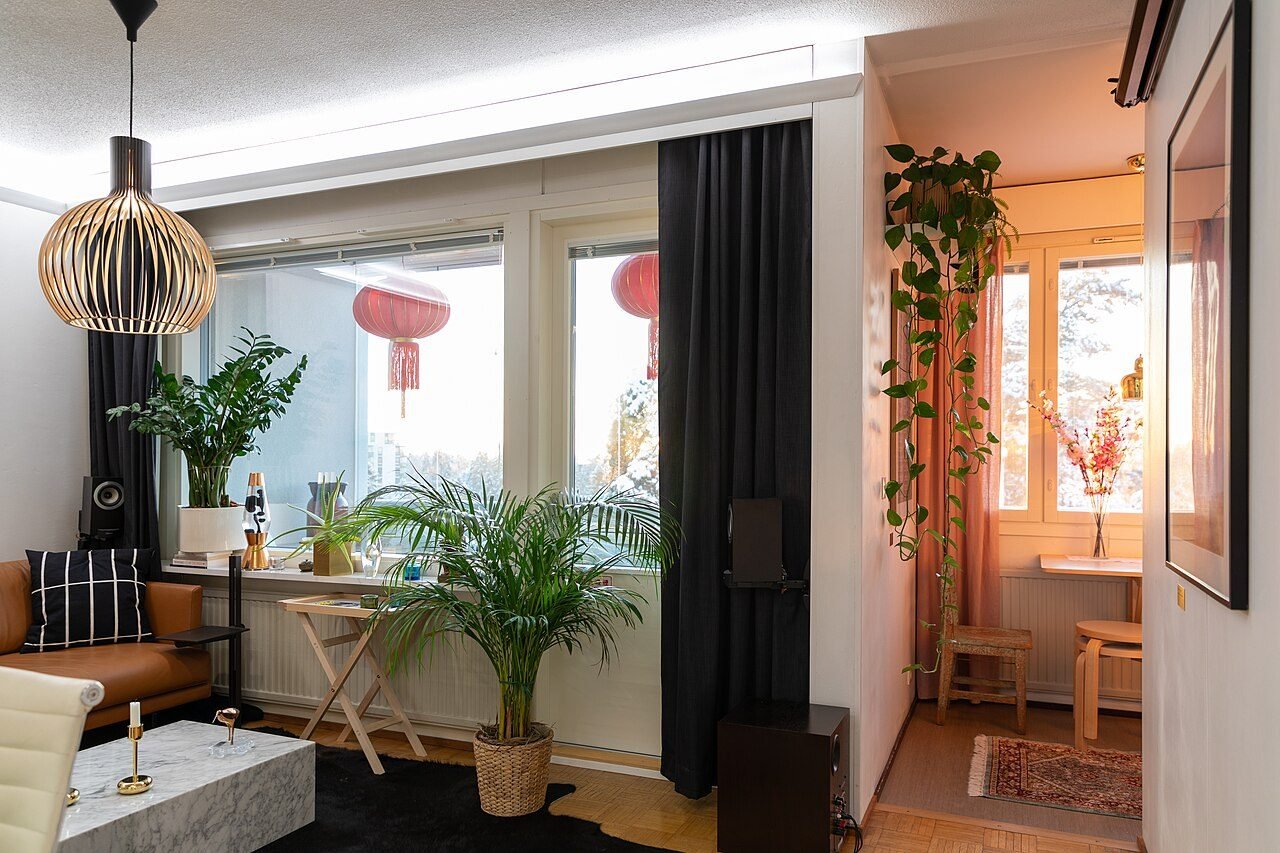
If you live in a small apartment, the “best” air purifier is mostly a sizing question. A machine that’s too small for the room will hum away without moving enough air to matter. One that’s far too big costs more, takes up floor space and is louder than you need.
The good news is that there’s one number that does most of the work: CADR. Once you understand it, choosing gets much easier.
How CADR works
CADR (clean air delivery rate) measures how much filtered air a purifier delivers, in cubic feet per minute (cfm), at its highest setting. It’s tested under a standard from AHAM (the Association of Home Appliance Manufacturers). Through its AHAM Verifide program, independent labs check that a model’s stated CADR holds up.
You’ll usually see three CADR numbers:
- Smoke: the smallest particles, around 0.1 to 1 micron.
- Dust: mid-sized particles.
- Pollen: the largest particles.
For fine particles such as PM2.5 and wildfire or bushfire smoke, the smoke CADR is the one to use. It’s normally the lowest of the three, so it’s the most conservative.
The two-thirds rule
The US EPA suggests choosing a portable air cleaner with a smoke CADR of at least two-thirds of the room’s floor area in square feet. That assumes a ceiling of about 8 feet; with higher ceilings, size up.
| Room size | Minimum smoke CADR (two-thirds rule) |
|---|---|
| 100 sq ft (about 9 m²) | 67 cfm |
| 150 sq ft (about 14 m²) | 100 cfm |
| 200 sq ft (about 19 m²) | 133 cfm |
| 300 sq ft (about 28 m²) | 200 cfm |
| 400 sq ft (about 37 m²) | 267 cfm |
Why two-thirds? With an 8-foot ceiling, it works out to about five air changes per hour: the purifier pushes the room’s full volume of air through its filter roughly five times an hour.
Reading “room size” claims on the box
Brands often print a recommended room size. Many US models use AHAM’s method, which assumes 4.8 air changes per hour in a room with an 8-foot ceiling. That works out to smoke CADR × 1.55 = recommended square feet, which is close to the EPA rule.
Watch out for much bigger numbers, such as “up to 1,000 sq ft”. These usually assume one air change per hour, which is far less filtration. If the box shows two room sizes, use the smaller one.
What a HEPA purifier does and doesn’t do
- A true HEPA filter is designed to capture fine particles: smoke, dust, pollen and pet dander.
- An activated-carbon pre-filter can reduce some odors, but a thin carbon layer has limited capacity for gases.
- Particle filters don’t remove carbon monoxide.
- A purifier doesn’t replace ventilation when the outdoor air is clean, or fix a mold or moisture problem.
The EPA advises choosing air cleaners that produce little or no ozone. In the US, the California Air Resources Board (CARB) keeps a list of certified air cleaners that meet its ozone emission limit. Several popular purifiers include an ionizer or similar feature. If yours has one, check whether you can switch it off.
How we picked
- Published smoke CADR from the manufacturer, ideally AHAM Verifide. We matched each model to a room size using the two-thirds rule.
- True HEPA filtration with replacement filters that are easy to buy.
- Renter-friendly: plugs into a standard outlet, small footprint, no installation.
- Widely available in the US. Most of these are sold in Australia too, sometimes as different model numbers, so check the local spec sheet.
- What we didn’t do: we haven’t run lab tests or hands-on testing of these units. The specs below are as published by each brand, and we’ve noted where sources disagree or where we couldn’t confirm a number.
Four purifiers matched to small spaces
For a bedroom or small home office (about 150–200 sq ft): Levoit Core 300
Brand-stated smoke CADR: 143 cfm. Levoit lists a recommended room size of 222 sq ft at 4.8 air changes per hour. Its larger “1,066 sq ft” figure is at one air change per hour. (Levoit Core 300-P)
Under the two-thirds rule, 143 cfm suits rooms up to about 215 sq ft. That fits a typical bedroom or a small studio sleeping area. It’s compact, and replacement filters are widely sold. The model has gone through versions (Core 300, Core 300-P, Core 300S with app control), and published figures differ slightly between them: Levoit lists the smart Core 300S-P at 141 cfm, for example. (Levoit Core 300S-P)
Check Levoit Core 300 on Amazon
For a studio or a small living room (about 250–350 sq ft): Coway Airmega AP-1512HH (“Mighty”)
Brand-stated CADR: 233 cfm smoke, 246 dust, 240 pollen (Coway’s published ratings). (Coway) Retailers list it for rooms of about 361 sq ft at 4.8 air changes per hour.
Under the two-thirds rule, 233 cfm covers about 350 sq ft, which is enough for many studios or an open living area. It has a long track record and is one of the most commonly reviewed purifiers in the US. It includes an ionizer, so check whether you can switch that function off if you’d rather avoid it, and look the model up on CARB’s certified list (linked under Sources) if ozone is a concern.
Check Coway Airmega AP-1512HH on Amazon
For the same size, as an alternative: Winix 5500-2
Published CADR: we couldn’t confirm a smoke CADR for this model from a source we could check, so read it off the box or Winix’s product page before you buy. Winix’s user manual gives a verified room size of 360 sq ft. (Winix 5500-2 manual, PDF)
Compared with the Coway, the Winix differs in shape, controls and filter design: it uses a washable pre-filter, a HEPA filter and a carbon filter. It has a “PlasmaWave” feature, an ionizing technology. The manual explains how to turn PlasmaWave on or off with its own button.
Note that Winix sells a newer model, the 5510, with a different rating. Don’t mix up the two models’ numbers.
For very small rooms (under about 150 sq ft): Blueair Blue Pure 411 series
Blueair’s 411 line is designed for small rooms such as a nursery-sized bedroom or a home office. It’s compact, light and simple to run.
We’re not quoting a CADR here because published figures vary between listings and between variants (411, 411 Auto, 411+, 411i Max). They range from about 105 to 132 cfm smoke. Pick the exact model you’re considering and check its smoke CADR on Blueair’s product page (Blueair Blue Pure 411i Max) against the table above before buying.
Check Blueair Blue Pure 411 models on Amazon
Quick comparison
| Model | Smoke CADR (published) | Fits rooms up to (two-thirds rule) | Notes |
|---|---|---|---|
| Levoit Core 300 | 143 cfm | ~215 sq ft | Compact; check which version you’re buying |
| Coway Airmega AP-1512HH | 233 cfm | ~350 sq ft | Includes ionizer |
| Winix 5500-2 | Check the model | Check the model (manual: verified room size 360 sq ft) | PlasmaWave can be switched off (manual) |
| Blueair Blue Pure 411 series | Varies by variant | Check the model | For the smallest rooms |
Specs as published by each brand, checked 31 Oct 2026. We haven’t measured them ourselves.
Getting the most from a small purifier
- Put it where you spend time. For most people that’s the bedroom overnight. The EPA suggests placing it in the room where people spend the most time.
- Close the door of the room you’re cleaning. A purifier sized for 200 sq ft can’t keep up with a whole open-plan apartment.
- Run it on a higher setting when it matters, for example during smoke events. The EPA advises running it continuously on high when smoke is present. Noise is the trade-off.
- Keep it a little away from walls and furniture so air can flow in and out.
- Change filters on schedule, and more often during heavy smoke. A clogged filter moves less air.
- Count the running costs. Before you buy, look up the price and availability of replacement filters, and the brand’s suggested replacement interval.
A note for renters
Purifiers are about as renter-friendly as clean-air upgrades get: no drilling, no landlord sign-off, and you take it with you. If your apartment gets smoky during fire season, see our guide to keeping indoor air cleaner during bushfire and wildfire smoke. Confused by filter labels? See true HEPA vs “HEPA-type”. To check how a purifier is doing in your room, see our guide to indoor air quality monitors.
Sources
- US EPA, Indoor Air Filtration (wildfire smoke): epa.gov/wildfires/indoor-air-filtration
- US EPA, Guide to Air Cleaners in the Home: epa.gov
- AHAM Verifide, air cleaner directory: ahamverifide.org
- California Air Resources Board, List of CARB-Certified Air Cleaning Devices: ww2.arb.ca.gov
- Health Canada, Using a portable air cleaner to improve indoor air quality during wildfire smoke events: canada.ca
- Manufacturer spec pages: Levoit, Coway, Winix (5500-2 manual), Blueair (plain links; brand affiliate programs pending)