
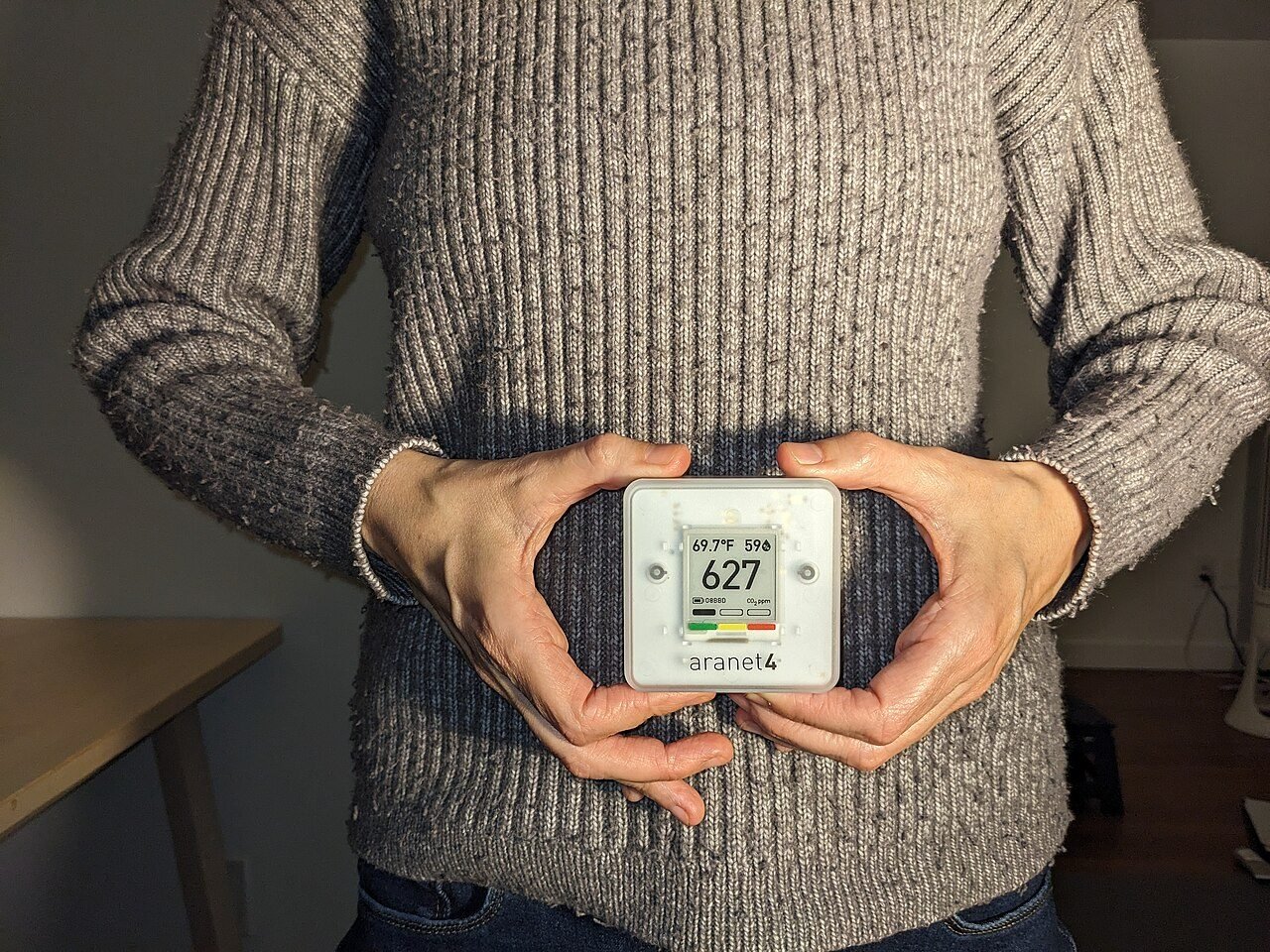
A home air quality monitor turns something invisible into a number on a screen. That can be useful: you can see what cooking does to the air in a small apartment, whether your purifier is keeping up during a smoky week, or whether a closed bedroom gets stuffy overnight.
It can also mislead. A green light doesn’t mean the air is “safe”, and a red one doesn’t mean you’re in danger. This guide explains what the two most common readings, PM2.5 and CO2, can and can’t tell you, and how to choose a monitor. We don’t make health claims; where health comes up, we point you to the EPA’s wording and to your doctor.
What a consumer monitor is (and isn’t)
The US EPA calls these devices low-cost air pollution monitors: devices that use one or more sensors to detect and report on specific pollutants, such as particulate matter or carbon dioxide, or environmental factors like temperature and humidity. (US EPA)
Three things the EPA is clear about:
- It’s not an alarm. Unlike carbon monoxide alarms or smoke detectors, the EPA says alerts from these monitors are not designed to warn of the potential for immediate danger to your health or life. Keep a certified CO alarm and smoke alarms regardless of what else you buy.
- It only sees what it’s built to see. A monitor designed only for particles won’t tell you about other pollutants. The EPA’s example: a PM-only monitor would not alert you to radon or carbon monoxide.
- The color bands are the maker’s choice. The EPA says there are no widely accepted air concentration limits for most pollutants indoors, so the levels that trigger an alert are set by each manufacturer. Two monitors can show different colors for the same air.
The EPA also notes that price doesn’t necessarily indicate performance. Cost tends to reflect the display, the housing, the number of sensors, connectivity and so on. (US EPA)
PM2.5: what the number means
PM2.5 is fine particulate matter: particles 2.5 micrometers across or smaller. The EPA describes particulate matter as a complex mixture of solid and/or liquid particles suspended in air that vary in size, shape and composition. (US EPA, Indoor PM) Consumer monitors usually report it in micrograms per cubic meter (µg/m³).
What a PM2.5 reading can tell you
- Change over time. This is where cheap sensors earn their keep. You can see the reading jump when you sear a steak or light a candle, and fall when you switch on the range hood or a purifier.
- Which activities matter in your home. The EPA lists cooking, burning candles, fireplaces, unvented heaters and smoking among indoor sources of PM. (US EPA, Indoor PM)
- Whether your fixes work. The EPA suggests using a monitor before, during and after an activity like cooking to see how it affects levels. If your PM monitor rises while you cook, the EPA suggests more exhaust ventilation, such as the range hood or an open window or door. (US EPA)
What it can’t tell you
- The exact concentration. The EPA says there’s limited information on the accuracy and precision of consumer monitors, and that placement, temperature, humidity and time in use can all affect them. Accuracy can vary between brands and even within one company’s product line. (US EPA)
- What the particles are. Many consumer PM sensors are optical: they detect light scattered by particles. ASTM’s standard test for indoor PM2.5 sensors notes that a sensor’s response relative to a reference monitor can vary by a factor of two for different particle types. Smoke, cooking particles and dust may all read differently. (ASTM D8405)
- Very small particles. The same ASTM standard says the lower detection limit for optical sensors is generally 0.3 µm.
- What it means for your health. The EPA says you can’t fully understand potential health impacts or risks from a monitor’s reading alone. If you have concerns or symptoms, talk to a health care provider. (US EPA)
CO2: a ventilation signal, not a pollution score
Carbon dioxide builds up indoors when people breathe in a room that doesn’t get much fresh air. That’s why a CO2 reading is mostly useful as a ventilation signal. For how to read indoor CO2 levels, follow the EPA’s guidance at US EPA.
What a CO2 reading can tell you
- When a room gets stuffy. A bedroom with the door and window shut overnight, or a home office in winter, will usually show CO2 rising through the day or night.
- When to air out. The EPA’s own example: if a CO2 monitor in a classroom shows rising levels, you may want to open a window to increase ventilation. (US EPA) The same logic works at home.
- Whether a change helped. Crack a window, run a bathroom fan, or leave the door ajar, and watch the trend.
What it can’t tell you
- Anything about particles or other gases. CO2 doesn’t measure smoke, cooking particles, carbon monoxide or radon. A low CO2 reading with a smoky room is entirely possible, for example when you’ve opened a window during a bushfire.
- A universal “safe” line. You’ll see thresholds quoted online. We haven’t used one here, and monitor makers set their own bands.
Don’t confuse CO2 with CO. Carbon monoxide (CO) is a different gas. The EPA says CO alarms should be certified to the most current UL Standard 2034 or the IAS 6-96 standard. (US EPA) An air quality monitor that shows CO2 isn’t a CO alarm.
How to choose a monitor
1. Decide what you want to measure
- Smoke, cooking, purifier performance: a monitor with a PM2.5 sensor.
- Stuffiness and ventilation: a monitor with a CO2 sensor. Look for one that measures CO2 directly rather than estimating it from other gases; the product listing should say how.
- Both: a combined unit. Many also report temperature and humidity.
Extra sensors (VOCs, formaldehyde) add cost. The EPA notes that these monitors only detect contaminants for which they are designed, so more sensors give more numbers, but not a complete picture. (US EPA)
2. Look for independent test results
Independent testing is the closest thing to a quality signal:
- AQ-SPEC. The South Coast Air Quality Management District runs the Air Quality Sensor Performance Evaluation Center, which tests commercially available sensors in the field and in a lab chamber and publishes the results. It doesn’t endorse products. (South Coast AQMD, AQ-SPEC) The EPA notes that independent evaluations have generally been based on outdoor conditions, which may not reflect indoor use.
- ASTM D8405. This is a standard test method for PM2.5 sensors used indoors, run in a chamber. (ASTM) South Coast AQMD says the PM2.5 test method was validated using its AQ-SPEC environmental test chamber. (South Coast AQMD) If a brand says its device was tested to ASTM D8405, ask for the report.
- The EPA doesn’t rate brands. It says it does not make recommendations or endorsements of specific indoor monitors, and generally evaluates sensors outdoors, not indoors. (US EPA) Treat “EPA-approved” marketing with suspicion.
3. Check the practical details
- Lifespan and calibration. The EPA says all monitors have a limited lifespan and can become less reliable over time, and suggests checking the maker’s service or replacement estimate before you buy.
- Indoor labeling. Choose a monitor labeled for indoor use. The EPA says it’s uncertain how outdoor-only monitors perform indoors.
- Data you can see over time. A trend graph is more useful than a single number.
- Power and connectivity. Battery, USB or mains; app or no app. If you’d rather not create an account, check whether the display works without one.
Where to put it
The EPA suggests placing a monitor in the breathing zone, about 3 to 6 feet off the floor for a typical adult, where air can flow into it freely, not against a wall. Keep it away from stoves, fireplaces, stored cleaning products, heating and cooling vents and open windows, which can skew the reading. (US EPA)
What to do with the numbers
The EPA’s three basic strategies for improving indoor air quality are source control, ventilation, and filtration and air cleaning. (US EPA) A monitor helps you see which one to reach for:
- PM spikes when you cook: range hood on, window open if the outdoor air is clean.
- PM stays high on smoky days: keep windows shut and filter the air. Our bushfire smoke guide covers what health agencies advise.
- PM is high in one room most of the time: a purifier sized to that room. See how CADR works and true HEPA vs “HEPA-type”.
- CO2 climbs overnight: more ventilation, if outdoor air allows.
Browse PM2.5 and CO2 monitors on Amazon (US). Check each listing for the sensor type and any independent test results.
How we picked what to cover
- We built this guide from the EPA’s consumer guidance on low-cost monitors, the ASTM D8405 test method summary, and South Coast AQMD’s AQ-SPEC program, linked where used.
- We link a search rather than a single product because we haven’t verified independent indoor test results for specific current models.
- We haven’t tested any monitors, and we don’t rank them.
- We make no health claims. A monitor reading isn’t medical advice.
Sources
- US EPA, Low-Cost Air Pollution Monitors and Indoor Air Quality: epa.gov
- US EPA, Can I measure carbon dioxide (CO2) indoors to get information on ventilation?: epa.gov
- US EPA, Indoor Particulate Matter: epa.gov
- US EPA, Air Sensor Toolbox: epa.gov
- ASTM D8405-21, Standard Test Method for Evaluating PM2.5 Sensors or Sensor Systems Used in Indoor Air Applications: astm.org
- South Coast AQMD, AQ-SPEC: aqmd.gov and ASTM test standards: aqmd.gov