
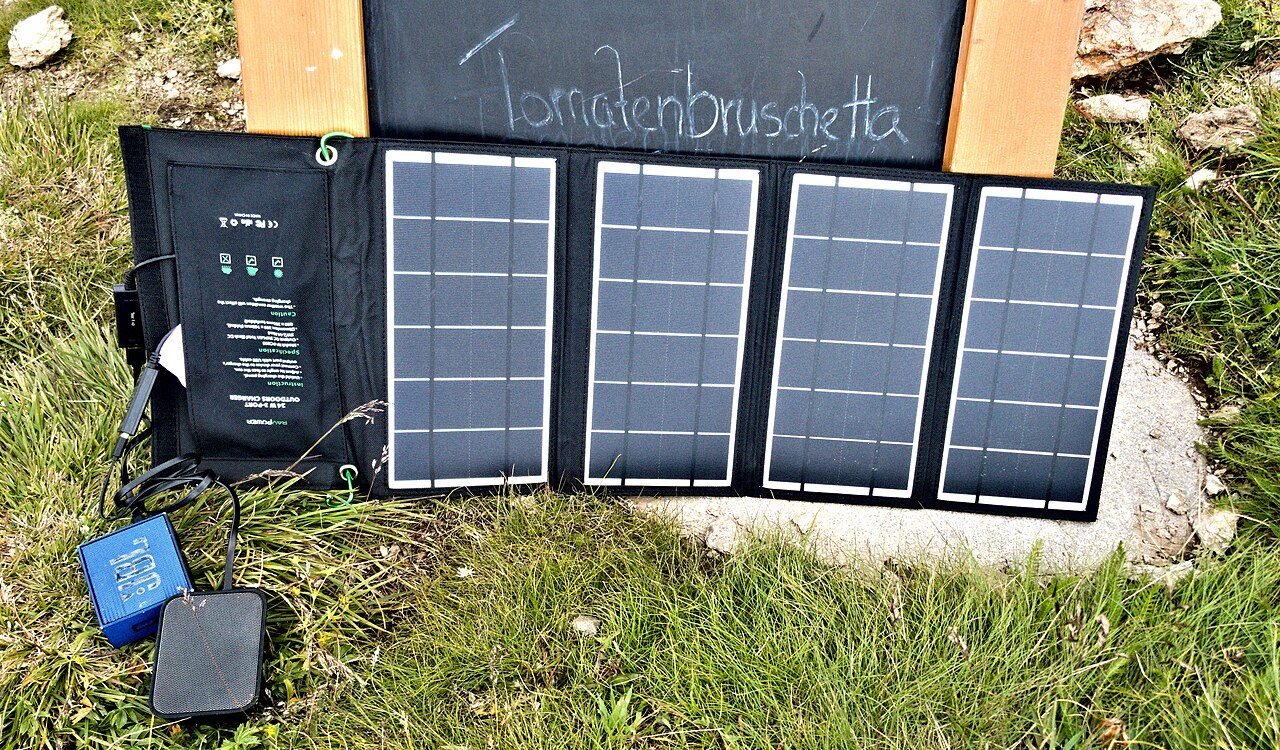
Featured photo: “Portable solar panel” by Tiia Monto, CC BY-SA 3.0, via Wikimedia Commons
Quick answer: A “solar generator” is a battery power station sold with solar panels, not a fuel generator. To size one for a power outage, add up the watt-hours your essentials use in a day (watts × hours), check the unit’s usable capacity and continuous output, and treat solar recharging as a bonus that varies with weather and season. It suits short outages and a short list of essentials, not a whole house for weeks.
Searches for “solar generator” in the US jumped last week, according to Google Trends data we checked on Monday, November 2, 2026, and “power outage” searches rose too. Before you buy, learn to read the label and do the arithmetic yourself.
What a “solar generator” actually is
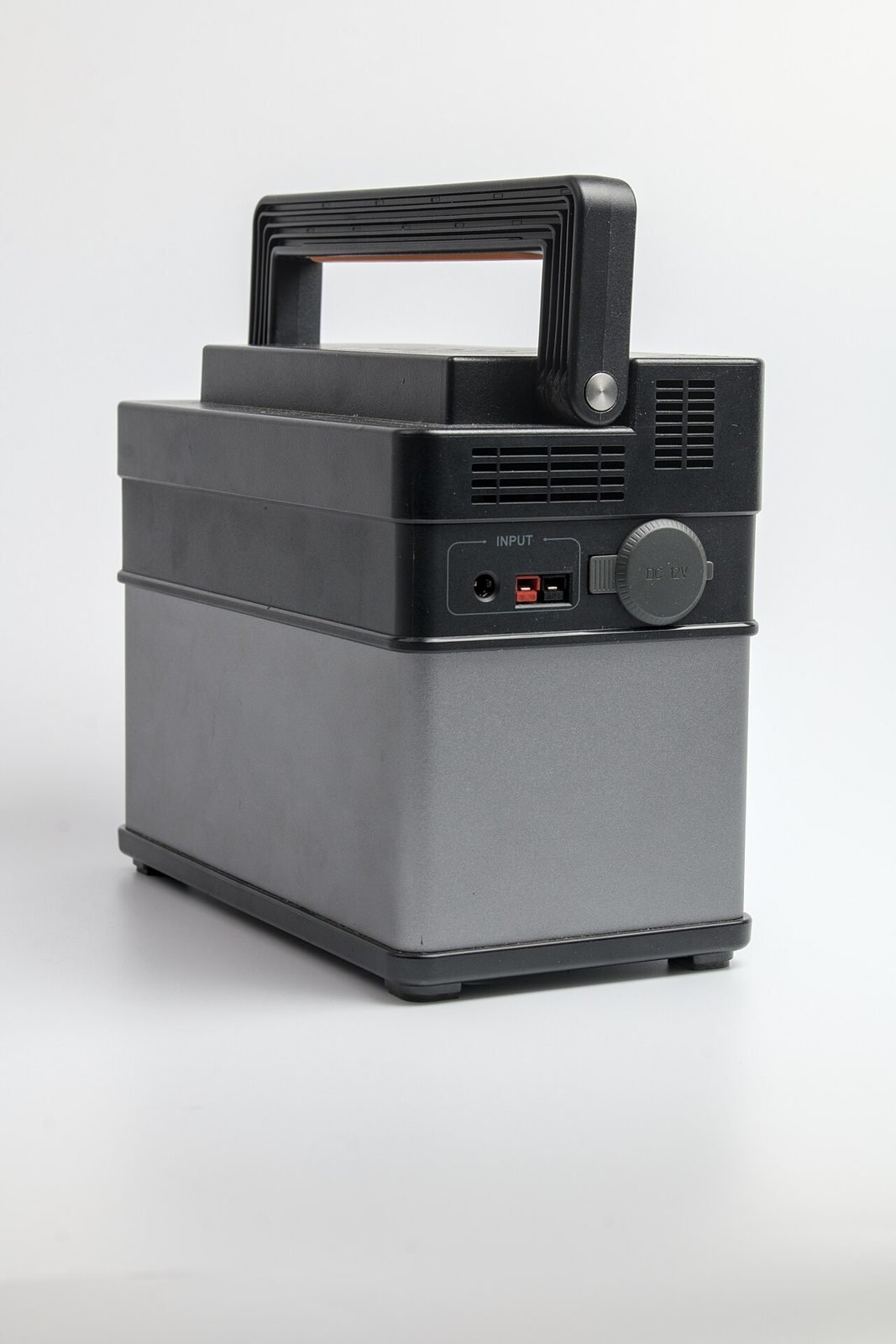
“Solar generator” is a marketing name. Inside the box is a rechargeable battery, an inverter that turns DC power into household AC power, and a charge controller. Panels are sold alongside it or separately. Nothing is burned; it stores electricity and releases it.
Two numbers matter most:
- Watt-hours (Wh) is capacity, like the size of a fuel tank.
- Watts (W) is output at a moment in time: how much it can supply at once (continuous) and for a brief startup spike (surge). A fridge compressor starting up asks for more than it uses while running.
For more detail, see how to read a power station spec sheet.
How to size one for an outage
- List your essentials. Ready.gov suggests listing the items you need that rely on electricity and planning for alternative power. Think fridge, phone charging, a few lights, your router, maybe a laptop.
- Find each item’s watts. Check the device or adapter label, or use a plug-in watt meter. Many appliances cycle on and off, so a full-day measurement beats a guess.
- Multiply watts by hours of use per day. The result is Wh per day. Add the rows up.
- Allow for conversion losses. Check the maker’s stated efficiency or usable capacity rather than assuming the headline Wh is what you can draw.
- Check peak watts. Compare what might run at the same moment with the unit’s continuous output, and keep the surge figure in mind for motors and compressors.
Fridges: use the label, not a guess
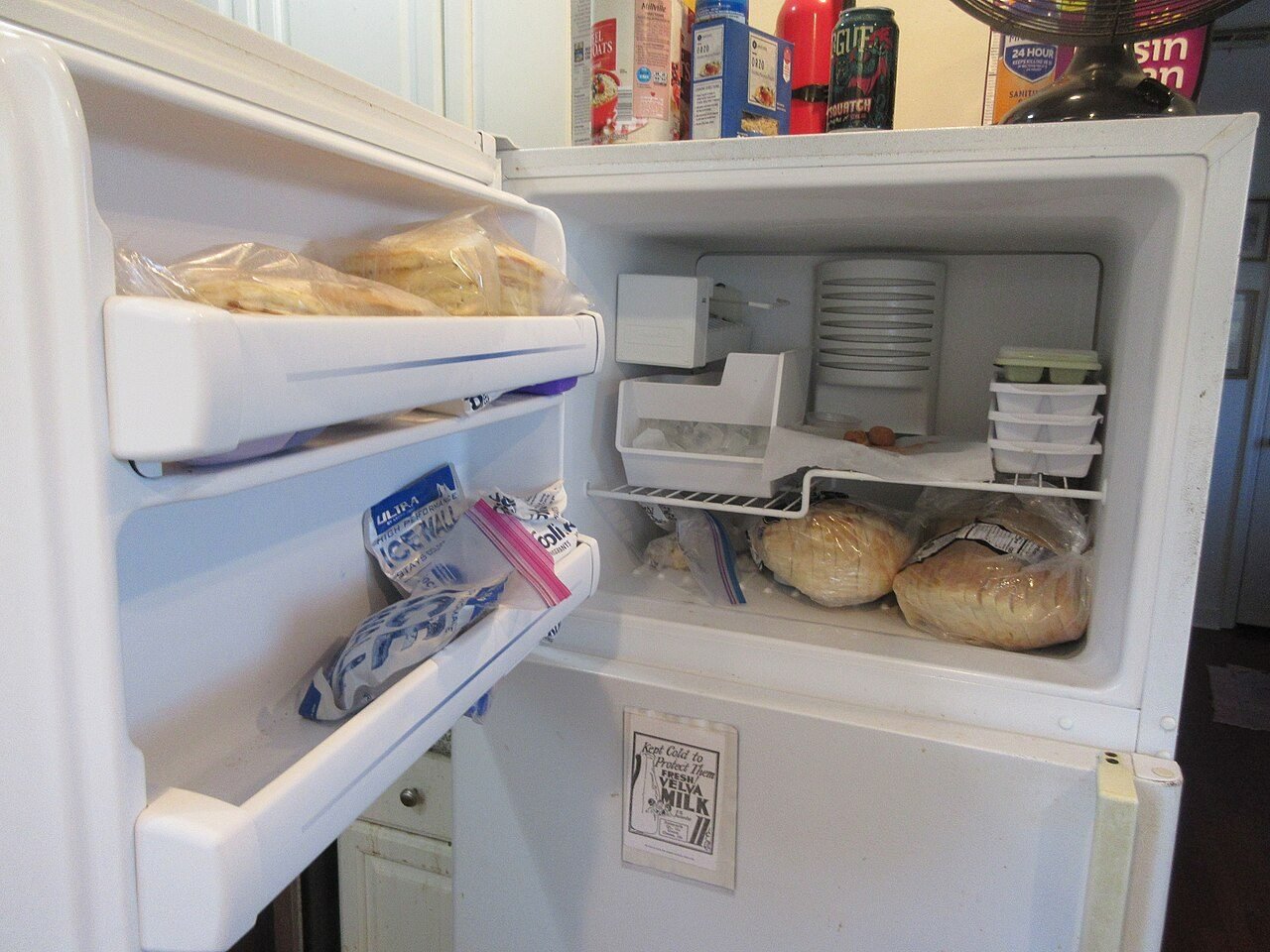
A refrigerator’s yellow EnergyGuide label shows its energy use and how it compares with similar models, based on typical use, according to the FTC. Divide the yearly kilowatt-hour figure by 365 for a rough daily number. Ready.gov advises keeping refrigerator and freezer doors closed, and says a refrigerator keeps food cold for about four hours and a full freezer for about 48 hours.
Example loads (assumed, not measured)
These wattages are assumed for illustration. Replace them with numbers from your own labels or a watt meter.
| Device | Typical watts (assumed example) | Hours/day assumed | Wh/day |
|---|---|---|---|
| Refrigerator | Check your EnergyGuide label; assumed 400 kWh/year (about 1.1 kWh/day) | 24 (it cycles) | about 1,100 |
| Wi-Fi router and modem | About 10 W (check the adapter label) | 24 | 240 |
| 4 LED bulbs | About 9 W each (check the bulb) | 5 | 180 |
| Laptop | About 60 W (check the adapter label) | 4 | 240 |
| 2 phones charging | About 15 W each (check the charger) | 2 | 60 |
| Total | about 1,820 |
That is roughly 1.8 kWh for one day of a modest list. A battery in the 1,000 Wh class would cover a bit over half of it before conversion losses, which is why the fridge is usually the deciding item. Cutting the laptop and extra lights stretches the battery, and solar input can top it up during daylight.
Medical devices: this is not medical advice. If you rely on a CPAP, oxygen concentrator or other powered device, ask your medical provider and the device’s maker how to keep it running in an outage.
Solar recharging: the honest version
A panel’s rated watts describe output under specific test conditions. Real-world output is usually lower and swings with season, cloud cover, angle and shade. November and December days are shorter, so there is less sun to collect.
NREL’s PVWatts calculator is a free tool for seeing how location and month change solar output. It models grid-connected rooftop or ground systems, not portable kits. OpenEI’s description of the tool calls it suitable for “very preliminary studies.” Use it only to see the seasonal pattern at your address.
About the “90-day outage” searches
“90 day power outage” searches also spiked, and some sellers use phrases like that in marketing. A portable power station is meant for short outages. Ready.gov notes that extended outages may impact whole communities, so a longer plan should cover water, food, heat or cooling, medications and communication.
Safety: what is different from a fuel generator
A battery power station burns no fuel, so it produces no exhaust at the point of use. EcoFlow describes its DELTA 2 as “indoor-friendly” and Bluetti says its AC180 is “designed for both indoor and outdoor scenarios.” Follow each maker’s manual for placement and temperature limits, and keep it dry.
Fuel generators are another matter. The US Consumer Product Safety Commission (CPSC) says:
“NEVER operate a portable generator inside a home, garage, basement, crawlspace, shed or other enclosed spaces.” It adds to operate them “outside only, at least 20 feet away from the house,” because opening doors or windows will not provide enough ventilation to prevent lethal carbon monoxide (CO) levels. (CPSC news release, December 12, 2025.)
Ready.gov recommends working carbon monoxide detectors on every level of your home.
Backfeeding is the other hazard. CPSC’s portable generator safety alert says to NEVER try to power the house wiring by plugging a generator into a wall outlet (“backfeeding”), which presents an electrocution risk to utility workers and neighbors. OSHA says never to attach a generator directly to a home’s electrical system unless a qualified electrician has properly installed it with a transfer switch. The same caution applies to a power station. To run home circuits, use a transfer switch or the maker’s home-panel kit, installed by a licensed electrician.
Battery chemistry: the Anker SOLIX C1000, EcoFlow DELTA 2 and Bluetti AC180 pages all list LiFePO4 (lithium iron phosphate) batteries. Anker states “3,000 cycles to 80%+ capacity,” EcoFlow “3000+ full charge and drain cycles” and Bluetti “3500+ cycles.” Those are the brands’ own figures, not independent test results.
Buying checklist
- Usable capacity (Wh): compare with your daily total from the table method above.
- Continuous and surge output (W): must exceed what runs at once and cover startup spikes.
- Max solar input (W and voltage): this limits how fast panels can recharge it.
- Expandable batteries: useful if your needs grow.
- Pass-through or UPS function: whether it can sit between the wall and a device. Treat any switch-over time as the maker’s claim; Anker lists “UPS Switch Time: <20ms” for the C1000.
- Warranty and weight: a 30-pound unit is a different carry from a 5-pound one.
- Recalls: search the brand and model on CPSC’s recall list (cpsc.gov/Recalls) before you buy.
Brand-stated figures from the makers’ own pages (checked November 2, 2026), not our test results:
- Anker SOLIX C1000: 1,056Wh; 1,800W AC continuous; 2,400W surge; solar input max 600W (11-60V); 5-year warranty; 28.44 lb; expandable to 2,112Wh.
- Bluetti AC180: 1,152Wh; 1,800W AC output; 2,700W in “Power Lifting Mode”; solar input 500W max; 5-year warranty; 35.3 lb.
- EcoFlow DELTA 2: 1,800W output (up to 2,200W with X-Boost); solar input up to 500W; 5-year warranty. EcoFlow’s page frames it as a 1 kWh-class unit.
- Jackery Explorer 1000 v2: check Jackery’s own spec page for current figures.
See also EcoFlow vs Jackery and what a power station runs.
See Anker SOLIX C1000 on Amazon (US)
Browse EcoFlow DELTA models on Amazon (US)
See Bluetti AC180 on Amazon (US)
See Jackery Explorer 1000 v2 on Amazon (US)
Search solar panels and power stations on Amazon (US)
Black Friday is coming: see judging green deals without prices.
How “green” is it?
A solar-charged battery avoids burning fuel at your home, so there is no on-site exhaust. It is not impact-free: the battery still has to be manufactured, and its footprint depends partly on the electricity that charges it. At end of life, the EPA says lithium-ion batteries “should be taken to separate recycling or household hazardous waste collection points,” and points to Earth911 and Call2Recycle. For how we weigh claims like “eco-friendly,” see how we judge green claims.
FAQ
Can a solar generator run my whole house?
Usually not. Most portable units are meant for essentials such as a fridge, lights, a router and device charging. Powering whole-house circuits needs a transfer switch or the maker’s home-panel kit installed by a licensed electrician, and the unit still has to meet your total demand.
How long will it run my fridge?
Divide the unit’s usable watt-hours by your fridge’s daily watt-hours from its EnergyGuide label or a plug-in watt meter, and expect some energy to be lost in conversion.
Can I use one indoors during an outage?
Makers such as EcoFlow and Bluetti describe their units as suitable for indoor use, so follow your model’s manual. Fuel generators are different and must never run in an enclosed space.
Do I need solar panels?
No. You can recharge from the wall before an outage. Panels help extend runtime, but output varies with weather, angle, shade and season.
What about medical devices?
Ask your medical provider and the device maker about a backup plan for powered medical devices.
How we wrote this
- Researched from official and maker sources on November 2, 2026; we did not test any product.
- Brand specs are quoted as the brand’s own claims.
- No brand paid for placement. Amazon links are affiliate links.
- Example wattages are labelled as assumptions; use your own labels.
Sources
- Ready.gov: Power Outages
- CPSC: winter storm safety tips (December 12, 2025)
- CPSC Safety Alert: Portable Generators
- OSHA: Using Portable Generators Safely
- FTC: Shopping for Home Appliances? Use the EnergyGuide Label
- NREL PVWatts (OpenEI)
- EPA: Used Lithium-Ion Batteries
- Call2Recycle drop-off locator
- Anker SOLIX C1000
- Bluetti AC180
- EcoFlow DELTA 2
- CPSC recalls