
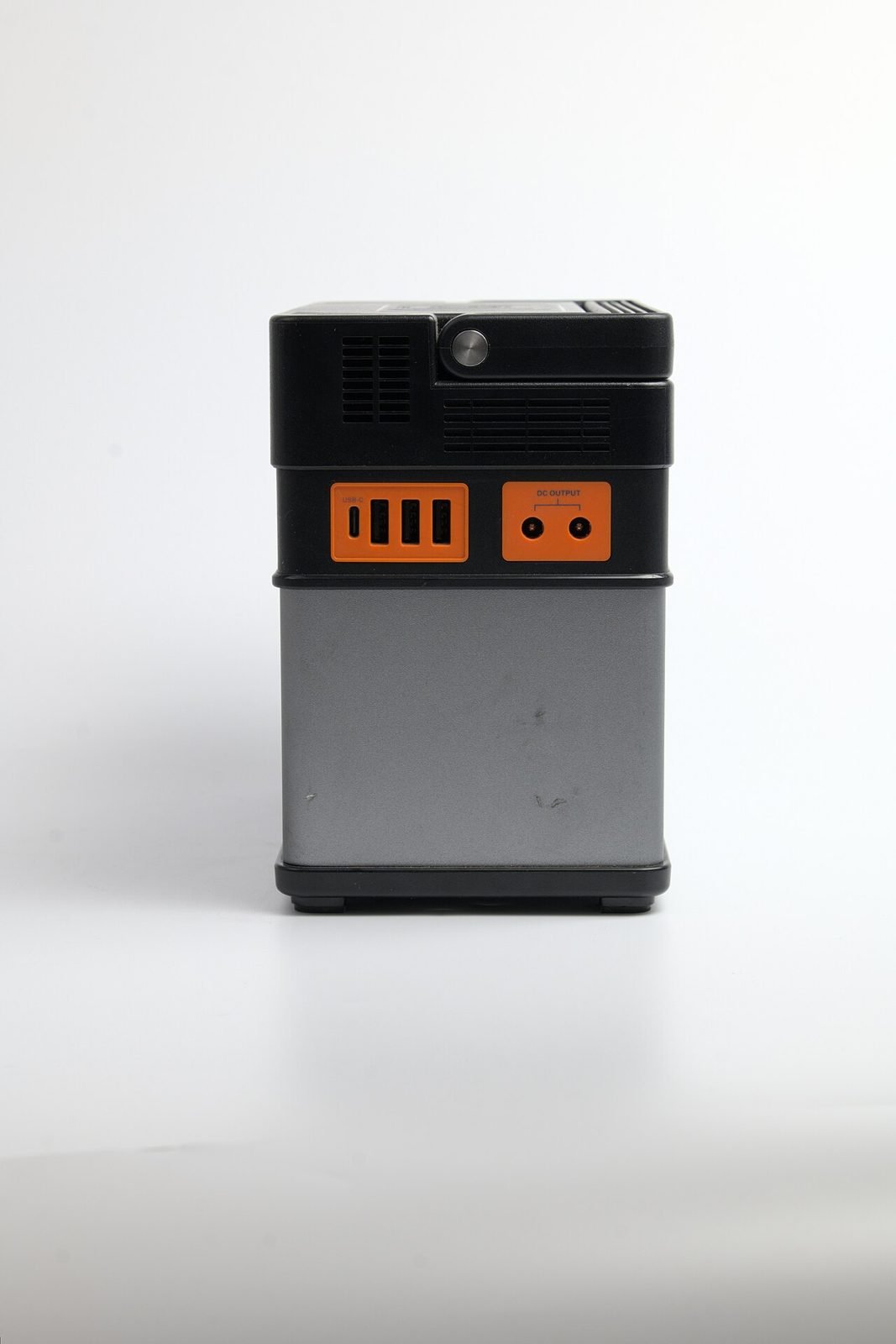
A portable power station on a campsite can feel like magic: lights, charged phones, cold drinks, no generator noise. It can also be a disappointment if you expected it to boil a kettle or run a heater all night.
What a power station can do comes down to two numbers and some simple sums. This guide walks through them with worked examples. Every product figure in the examples below is hypothetical, chosen to make the maths easy. Use your own station’s spec sheet and your own devices’ labels for real planning.
The two numbers: watts and watt-hours
- Watts (W) are power: how fast energy is used. A device’s wattage says how much it draws at any moment. A station’s output rating in watts says the most it can deliver at once.
- Watt-hours (Wh) are energy: how much is stored. A station’s capacity in Wh is the size of the tank.
A useful picture: watts are the width of the pipe, watt-hours are the size of the tank. A big tank with a narrow pipe can run small things for a long time but can’t run one big thing at all. A wide pipe with a small tank can run a big thing, briefly.
Two questions follow for every device:
- Can the station run it at all? The device’s watts must be under the station’s continuous output rating (and its start-up surge under the surge rating).
- For how long? Divide the energy available by the device’s watts.
If a spec sheet gives a battery’s size in amp-hours, the FAA gives the conversion: to calculate Wh, multiply the battery voltage by the Amp hours. (FAA PackSafe) For the rest of the spec sheet, see how to read a portable power station spec sheet.
The planning formula
Runtime (hours) ≈ capacity (Wh) × planning allowance ÷ device watts
The planning allowance covers energy lost converting battery power into AC or USB output. It varies by model and load, so if your brand publishes a usable-capacity or efficiency figure, use that. For the examples here we use 0.85. That’s our own assumption for illustration, not a measured or brand figure, and it’s the same allowance we use in our EcoFlow vs Jackery comparison.
Our hypothetical station
For all the examples below, imagine a mid-size camping station with:
- Capacity: 500 Wh (hypothetical)
- Continuous AC output: 300 W (hypothetical)
- Usable energy for planning: 500 × 0.85 = 425 Wh
Worked examples
All device wattages below are hypothetical round numbers. Check the label or the manual on your own device, or measure it with a plug-in power meter at home.
Example 1: LED string lights (hypothetical 5 W)
- Can it run? 5 W is far below 300 W. Yes.
- How long? 425 ÷ 5 = 85 hours.
Low-watt lighting is where power stations shine. Several evenings of lights barely dents the battery.
Example 2: charging phones (hypothetical 15 Wh per full charge)
Phones are easier to think about in watt-hours per charge than in watts.
- How many charges? 425 ÷ 15 ≈ 28 full charges.
In practice you’ll get fewer if you charge through the AC outlet with a plug-in charger rather than the station’s USB ports, because that adds another conversion step. Use the USB ports where you can.
Example 3: a laptop (hypothetical 60 W while working)
- Can it run? Yes.
- How long? 425 ÷ 60 ≈ 7 hours of use.
Example 4: a 12 V compressor cooler-fridge (hypothetical)
Fridges are the tricky one, because they cycle on and off. The label wattage is what the compressor draws while running, not the average over a day.
Suppose (hypothetically) a 12 V fridge draws 45 W when running and, on a mild day, runs one-third of the time:
- Average draw: 45 × ⅓ = 15 W
- Energy per day: 15 × 24 = 360 Wh
- Days on our station: 425 ÷ 360 ≈ 1.2 days
On a hot day, with the lid opened often, it would run more and the battery would last less. Plug the fridge into the station’s 12 V DC socket if it has one; it avoids the AC conversion.
Example 5: an electric kettle (hypothetical 1,200 W)
- Can it run? No. 1,200 W is four times our station’s 300 W continuous output. The station will refuse or shut off, however full the battery is.
Even on a station big enough to power it, a kettle is a heavy user of stored energy: 1,200 W for 5 minutes is 100 Wh before losses, about a quarter of our hypothetical station’s usable energy for one boil. A camp stove is usually the better tool for heating water.
Example 6: an electric space heater or hair dryer (hypothetical 1,500 W)
Same as the kettle: too much for most mid-size stations, and even on a large one it would drain the battery fast. Plan on warm layers and a good sleeping bag instead.
The examples at a glance
| Device (hypothetical figures) | Draw | Runs on our 300 W station? | Rough runtime on 425 Wh |
|---|---|---|---|
| LED string lights | 5 W | Yes | ~85 hours |
| Phone, per charge | 15 Wh | Yes | ~28 charges |
| Laptop | 60 W | Yes | ~7 hours |
| 12 V fridge (average) | 15 W avg | Yes | ~1.2 days |
| Electric kettle | 1,200 W | No | n/a |
| Space heater / hair dryer | 1,500 W | No | n/a |
All figures are illustrations, not product specs. Real results vary with temperature, device settings and the station itself.
Adding up a trip
To size a station for a weekend, list each device, estimate how many watt-hours it uses per day, and add them up. Hypothetically:
| Device | Use per day | Wh per day |
|---|---|---|
| Lights (5 W) | 4 hours | 20 |
| Two phones (15 Wh each) | 1 charge each | 30 |
| Fridge (15 W average) | 24 hours | 360 |
| Total | 410 Wh/day |
On our hypothetical 425 Wh, that’s about one day. For a two-night trip without recharging, you’d want roughly twice the capacity, or a way to recharge, or a cooler with ice instead of the fridge.
The exercise usually shows that one device dominates. Here it’s the fridge. Cut that, and the same station lasts many days.
Recharging at camp
- Solar: don’t plan on a panel delivering its full rated wattage all day; sun angle, cloud and shade all reduce what it puts out. For a cautious plan, assume well under the rating. As a hypothetical: a 100 W panel averaging 50 W over 5 hours of good sun puts back about 250 Wh before charging losses. Check that the panel’s voltage falls within your station’s solar input range.
- Car charging: a 12 V car socket can top up a station on the drive. Check your vehicle’s manual before using the socket with the engine off.
- Campground hookups: if your site has power, recharge there. Rules on what you can plug in vary by campground.
Flying to your campsite?
Most camping-size stations can’t fly. The FAA limits lithium ion (rechargeable) batteries to a rating of 100 watt hours (Wh) per battery for passengers, carried in carry-on baggage only. With airline approval, passengers may also carry up to two spare larger lithium ion batteries of 101–160 Wh. (FAA PackSafe) The FAA says a device with a lithium ion battery that exceeds 160 Wh is prohibited as carry-on or checked baggage. (FAA PackSafe) The TSA adds that spare lithium batteries, which include both power banks and phone chargers, are prohibited in checked luggage. (TSA)
Our 500 Wh example station couldn’t fly. If you’re flying, a power bank of 100 Wh or less (with the rating printed on it) and a small solar panel may be the practical answer. The FAA also notes that many airlines set stricter limits, so check yours.
Looking after it
The FAA notes that all lithium ion batteries are capable of overheating and undergoing a process called thermal runaway. (FAA PackSafe) At camp, follow the manufacturer’s temperature and charging instructions, keep the station out of rain and direct midday sun, and stop using any unit that’s swollen or damaged.
Choosing one
Start with your list, not with the biggest box in the shop:
- Write down every device and its watts (or Wh per charge).
- Check the biggest draw against the continuous output rating.
- Add up Wh per day, apply your planning allowance, and multiply by the days between recharges.
- Add some headroom, then compare models at that size.
Browse portable power stations on Amazon (US) · Browse 12 V camping fridges on Amazon (US)
Buying one that will last, and repairing gear rather than replacing it, matters more than the “green” label on the box; see buy-less outdoor gear. And if you’re buying in the sales, our Black Friday green deals guide helps you avoid paying for capacity you won’t use.
How we wrote this
- Every device and station figure in the worked examples is hypothetical and labelled as such. The 0.85 planning allowance is our assumption, not a brand or test figure.
- Flying rules are quoted from the FAA and TSA and linked. Rules outside the US differ; check your airline and aviation regulator.
- We don’t name a “best” station here; our EcoFlow vs Jackery comparison compares two real models using brand-stated specs.
- We haven’t tested any units, and no brand paid to be included. If you depend on a medical device, ask its manufacturer about running it from a power station.