As decorating season starts, the lights aisle (or the attic box) raises a fair question: are LED strands really different from the classic glass-bulb kind, or is it mostly marketing? Here is a calm, practical comparison of cost, safety and look, so you can decorate with confidence and waste as little as possible.
Quick answer: LED strands use a small fraction of the electricity of incandescent ones and run cooler, and warm white LEDs can look very close to the old glow. But a lab-tested strand, the right indoor or outdoor rating, and sensible electrical habits matter more than the bulb type. If your incandescent strands still work and you check them over, there is no need to throw them out; when they die, replace them with LEDs and recycle the old ones.
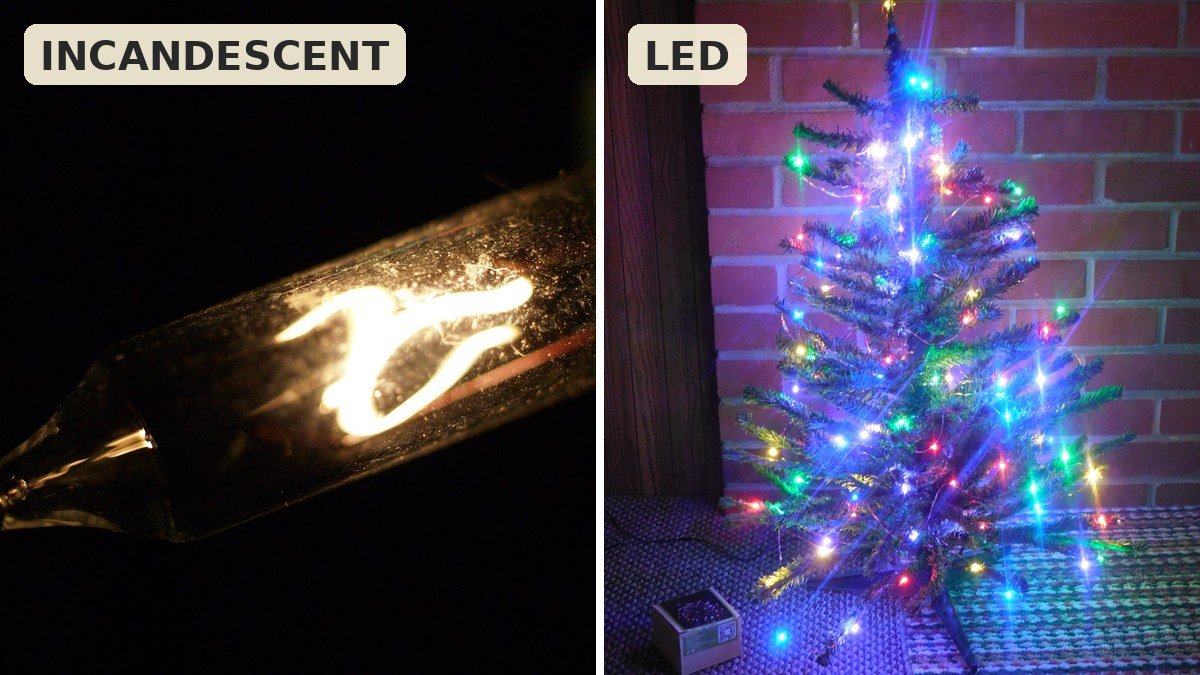
Featured photo (top), composite: “Christmas Lightbulb” by Towel401 / Wikimedia Commons, Public domain; “LED Christmas Lights on a Tree” by HeatherMarieKosur / Wikimedia Commons, CC BY-SA 4.0 (cropped and combined; composite shared under CC BY-SA 4.0).
What is actually different?
An incandescent bulb makes light by heating a tiny wire filament until it glows. Most of the energy becomes heat, which is why the bulbs feel warm to the touch. An LED (light-emitting diode) makes light electronically in a small chip, so far less energy is wasted as heat.
That one difference explains most of the rest: LEDs draw fewer watts, stay cooler, and can be made in a wider range of colors. Incandescent mini bulbs have a soft, slightly flickery, golden glow that many people associate with Christmas. Early LEDs were often a harsh bluish white, which is where the "LED lights look cold" reputation comes from.
Warm white, cool white and the look people love
Light color is described by color temperature in kelvins (K). Lower numbers look warmer and more golden; higher numbers look whiter and bluer. As an illustration, warm white LED strands are often in the range of roughly 2700K to 3000K, close to a traditional incandescent glow, while cool white sits much higher. Packaging does not always list the number, so look for the words "warm white," "soft white" or "candle glow" and compare in person if you can.
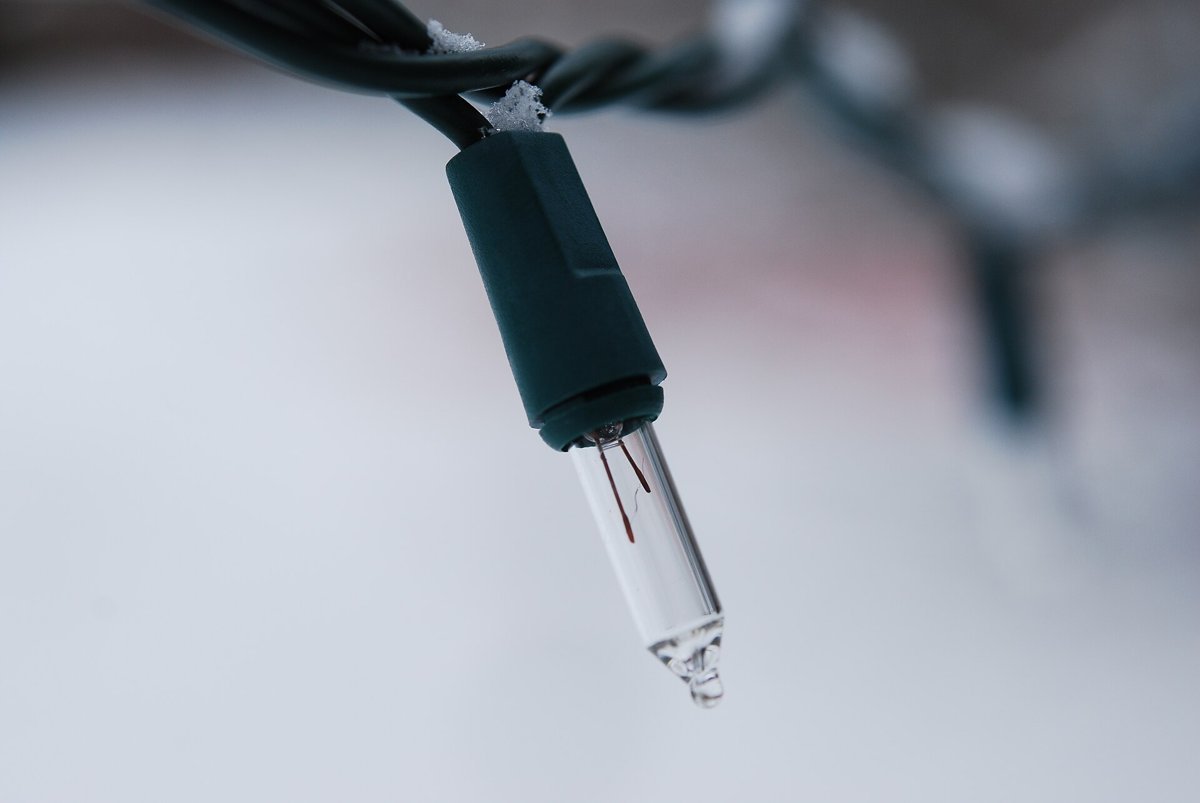
A few more look-related points:
- Bulb size: mini lights suit trees, garlands and railings. Larger C7 and C9 bulbs give the classic roofline look.
- Faceted vs smooth: faceted (cut-glass style) lenses sparkle more; smooth, frosted or "vintage" style bulbs look softer and closer to old-fashioned glass.
- Mixing types: LED and incandescent strands on the same tree can look uneven because the color and brightness differ. If you are switching gradually, try keeping one type per tree, wreath or doorway.
- Twinkle: some LED sets include steady-on, fade or twinkle modes. If you love the subtle shimmer of old bulbs, a fade or slow-twinkle setting can be a good match.
LED vs incandescent Christmas lights at a glance
| Feature | LED | Incandescent |
|---|---|---|
| Energy use | Low; often a small fraction of an incandescent strand of similar length | Higher; the filament turns much of the power into heat |
| Heat | Bulbs stay cool or only slightly warm | Bulbs get warm, and larger C7/C9 bulbs get noticeably hot |
| Light look | Wide choice; warm white versions can closely match the old glow | Soft, golden, slightly flickery glow |
| Durability | Plastic or epoxy lenses are usually harder to break than glass | Glass bulbs can crack, and filaments can burn out |
| Strands end to end | Usually many more per outlet or cord, because each strand draws little power; follow the tag | Usually fewer, because each strand draws more power; follow the tag |
| Typical upfront cost | Higher per strand | Lower per strand |
| Best for | Long hours, big displays, timers, anyone wanting lower running cost | Strands you already own, or a particular traditional glow |
Energy use and running cost: a worked example
Wattage varies a lot by strand, so please treat the numbers below as illustrative and check the label on your box or tag for the real figure. We assumed 6 hours per night for 30 nights, or 180 hours, and an electricity rate of 18 cents per kWh, which is roughly the US average residential price per the U.S. Energy Information Administration (EIA): 18.16 cents per kWh for August 2026, in its Electric Power Monthly released in October 2026. Your own rate will differ.
The math is simple: watts x hours / 1,000 = kWh, then kWh x rate = cost. For example, a 40-watt strand for 180 hours is 40 x 180 / 1,000 = 7.2 kWh, and 7.2 x 0.18 is about 1.30 dollars.
| Strand (illustrative) | Watts | Hours in season | kWh | Approx cost at 18 cents per kWh |
|---|---|---|---|---|
| 100-bulb mini, incandescent | 40 | 180 | 7.2 | about 1 dollar 30 cents |
| 100-bulb mini, LED | 5 | 180 | 0.9 | about 16 cents |
| 25-bulb C9, incandescent | 175 | 180 | 31.5 | about 5 dollars 70 cents |
| 25-bulb C9, LED | 18 | 180 | 3.2 | about 58 cents |
This is an estimate, not a measurement. The takeaway: a single mini strand costs little to run either way, so you will not see a dramatic bill change from one string. The gap grows with big outdoor displays and long hours, where incandescent C9 strands add up. A plug-in timer helps with both types, because the cheapest hour of lighting is the one you do not need.
Lifespan and durability
LED bulbs generally last longer than incandescent filaments, and plastic or epoxy lenses survive drops and winter storage better than thin glass. Manufacturers often advertise many seasons of use, but claims vary by product, so treat them as a rough guide rather than a promise.
What about "one bulb out, the whole strand out"? On some older incandescent strands wired in series, a failed or loose bulb can darken a section or the full strand. Many modern strands (both types) are built to keep working when one bulb fails, but it varies by product. Check the packaging, and keep a spare-bulb pack with any strand that includes one.
ENERGY STAR has had a program for decorative light strings, but we could not confirm how widely labeled strands are available this season, so we do not rely on the label here. If you see one, it is a useful extra, but not a substitute for the lab mark below.
Heat and safety
Cooler bulbs are a real advantage near dry greenery. But LED does not mean risk-free: the wiring, plugs, sockets and extension cords carry the same electricity, and damage or overload can cause trouble with any type. These steps apply to both:
- Look for a testing-lab mark. The Consumer Product Safety Commission (CPSC) advises using only lights tested by a nationally recognized testing laboratory. Common marks include UL, ETL (Intertek) and CSA.
- Match the rating to the place. CPSC says to check for labels showing the lights are certified for outdoor use. Use indoor-only strands indoors.
- Inspect before use. CPSC advises checking each set, new or old, for broken or cracked sockets, frayed or bare wires, and loose connections, and throwing out damaged sets.
- Respect the connection limit. Connect only as many strands end to end as the manufacturer allows, which is printed on the tag or box. Electrical safety groups give the same advice.
- Do not overload cords. CPSC says to use extension cords rated for the intended use and in good condition, and not to use cords with cuts or fraying. Adding up the watts on your cord’s label is a sensible habit.
- Turn them off when you leave or sleep. A timer makes this effortless.
Heaters are another seasonal electrical load worth a second look; our space heater safety and efficiency guide covers keeping cords and outlets happy during cold weeks.
Mixing LED and incandescent strands
Do not connect LED and incandescent strands end to end unless the manufacturer’s tag says it is allowed. They draw very different power, and the connection limits on the tag assume the same type of strand. When in doubt, plug each strand into its own outlet or a suitable cord.
Hanging lights outdoors
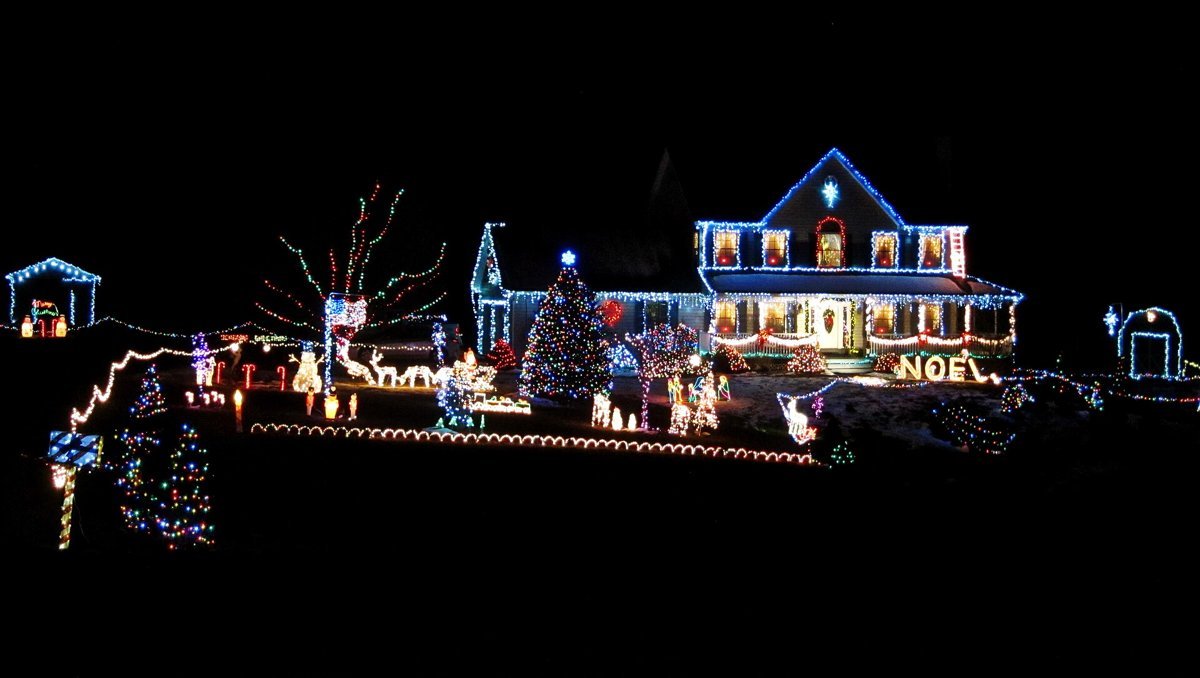
Outdoors, use only strands and cords marked for outdoor use. CPSC advises plugging them into a GFCI-protected receptacle or a portable GFCI, which cuts power quickly if current leaks to ground. Most newer homes have GFCI outlets outside, and portable GFCI adapters are widely sold.
Ladders deserve as much attention as the wiring. In a release dated December 2017, CPSC estimated 14,700 emergency-room-treated holiday decorating injuries in the previous holiday season, and falls were the most frequent type, at 41 percent. Set the ladder on firm, level ground, keep your body centered, and ask someone to steady it.
To attach strands, plastic clips made for lights are our suggestion over nails or staples, which can pierce the wire insulation. Do not yank on lights to pull them down; pulling on outdoor lights can strain the connections.
Renters and apartment dwellers can use the same ideas on a smaller scale; our balcony and small-space outdoor living guide has ideas for cozy lighting without drilling or a big setup.
Solar string lights: an honest option
Solar-powered outdoor strings need no outlet, which suits a fence or garden. The trade-offs are that they are usually dimmer than plug-in strands, and the run time depends on weather and how much sun the panel gets in December. They work best as gentle accent lighting. For a realistic view of what small solar gear can and cannot do, see our solar power bank guide.
Low-waste thinking: use up, then recycle
Making any new strand takes materials and energy, so the greenest strand is often the one you already own. If an incandescent strand works and passes the inspection above, keep using it, ideally with a timer. When a strand fails or is damaged, replace it with an LED and recycle the old one rather than tossing it in the trash.
Recycling options vary by area. Some county and city programs accept holiday lights at drop-off sites or collection events; for example, King County in Washington and Howard County in Maryland publish holiday light recycling pages. Some private companies also run mail-in programs for string lights. Terms change, so check your local waste or recycling site before you go or ship anything.
Gifting a good strand or a timer to a neighbor is another low-waste idea; our low-waste gift guide has more. If you are buying new, you may also like our Black Friday green deals roundup.
A quick buying and setup checklist
- Look for a testing-lab mark (UL, ETL/Intertek or CSA) on the tag or plug.
- Check the indoor or outdoor rating, and use each only where it belongs.
- Choose warm white or cool white deliberately, and try to keep one color type per tree or doorway.
- Pick the bulb size for the job: mini for trees and garlands, C7 or C9 for rooflines.
- Read the maximum number of strands that can be connected end to end.
- Add a timer or smart plug so lights are off when you sleep or leave.
- Plug outdoor lights into a GFCI-protected outlet.
- Keep old strands that work and pass inspection.
- Recycle dead strands through a local or mail-in program.
Products to look for
- Warm white LED mini string lights, UL or ETL listed: for trees, garlands and mantels; look for a clear indoor/outdoor rating and a stated connection limit.
- LED C9 outdoor bulbs or strings: a lower-wattage way to get the classic roofline look; check the outdoor rating and connection limit.
- Outdoor plug-in timer or outdoor smart plug: to cut hours and automate on/off; check the outdoor rating and the watts it can handle.
See warm white LED Christmas lights on Amazon (US)
See LED C9 outdoor Christmas lights on Amazon (US)
See outdoor timers and smart plugs on Amazon (US)
Confirmed vs. not
Confirmed guidance (as of 19 November 2026):
- CPSC holiday decorating release (December 2017): use lights tested by a nationally recognized lab, check for outdoor-use labels, inspect for damaged sockets and wires, use GFCI protection outdoors, use properly rated cords; falls were the most frequent decorating incident.
- Electrical safety groups: use outdoor-rated lights outdoors and connect only the number of strands the manufacturer recommends.
- EIA Electric Power Monthly (released October 2026): US average residential price of 18.16 cents per kWh for August 2026, preliminary.
Estimates and suggestions: the wattages and costs in the table are illustrative and will differ by product and electricity rate; lifespan claims vary by maker; plastic clips instead of nails, color temperature ranges, and the look comparisons are our suggestions or general product information, not official rules.
Choosing the tree itself? Our real vs artificial Christmas tree guide compares footprint, care and fire safety.
FAQ
What is the difference between LED and incandescent Christmas lights?
Incandescent bulbs glow by heating a filament, which wastes much of the energy as heat. LEDs make light electronically, so they use less power, run cooler and come in more colors, including warm white.
Do LED Christmas lights save money?
Usually yes in running cost. In our illustrative example, a 100-bulb mini strand costs about 16 cents to run for a season as an LED versus about 1 dollar 30 cents as an incandescent. The savings grow with larger displays and longer hours, though LED strands usually cost more upfront.
Are LED Christmas lights safer?
They run cooler, which helps, but they are not risk-free. Choose lab-tested strands, match the indoor or outdoor rating, inspect for damage, do not overload cords, and turn lights off when you leave or sleep.
Can I connect LED and incandescent strands?
Not unless the manufacturer’s tag says you can. They draw very different power, so check the tag and otherwise use separate outlets or cords.
Should I throw out my old incandescent lights?
No, not if they work and pass inspection. Using what you own avoids new waste. Replace strands only when they fail or are damaged, then recycle them through a local or mail-in program.
How we wrote this
- Researched from official guidance and manufacturer or spec information, not hands-on tested.
- No brand paid for placement or reviewed this article.
- Wattages and costs are labeled illustrative; always check the label on your own strand.
- Facts were last checked on 19 November 2026.
Sources
- CPSC: Put Safety at the Top of Your List When Decorating this Holiday Season
- EIA Electric Power Monthly, Table 5.6.A
- Electrical Safety Foundation International: Outdoor Decoration Safety Tips
- Safe Electricity: Holiday Light Safety
- ENERGY STAR: Decorative Light Strings
- Howard County, MD: Holiday light recycling
- King County, WA: Holiday lights recycling
Written by the Sunshine and Fresh Air team. Last checked: 19 November 2026.