
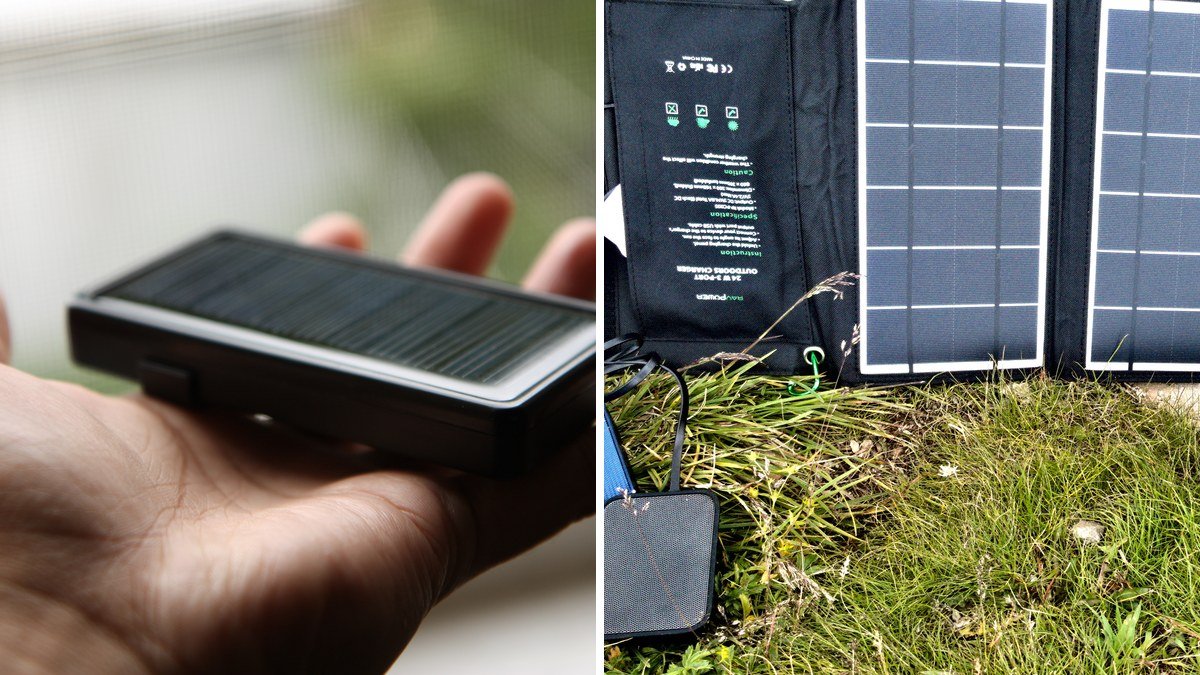
A solar power bank looks like the simple answer for a camping weekend or a winter storm: a battery that fills itself from the sun. The honest picture is more modest, and knowing it before you buy saves frustration. This guide covers how they work, how big a battery you need, what the airline rules say, and when a different tool is the better pick as winter storm season and holiday gifting start.
Quick answer: Yes, they work, but the small built-in panel on a phone-sized power bank charges very slowly. Think of it as an emergency trickle, and charge from a wall outlet before you leave. For real sun charging, pair a regular power bank with a separate foldable panel. Most power banks up to about 27,000 mAh sit at or under the 100 Wh airline limit, but they must go in your carry-on, never checked baggage.
Featured photo (top), composite: “Solar charger 5” by Mark Guim / Wikimedia Commons, CC BY 2.0; “Portable solar panel” by Tiia Monto / Wikimedia Commons, CC BY-SA 3.0 (cropped and combined; composite shared under CC BY-SA 4.0).
How a solar power bank works (and the honest reality)
A solar power bank is an ordinary lithium-ion power bank with a small solar panel on one face. Sunlight on the panel sends a small current into the internal battery. Treat sun charging as a bonus, not the main way to fill it: check the product page for the panel’s rated output and any solar charging time it states, and note whether it describes solar as a backup or emergency feature.
Here is a worked example. The numbers are illustrative estimates, not product claims.
- A 10,000 mAh bank stores about 10,000 x 3.7 / 1,000 = 37 Wh.
- Say the built-in panel is rated at 2 W. In good direct sun, with angle, heat and charging losses, you might average about 1 W.
- 37 Wh divided by 1 W is roughly 37 hours of good sun. At 4 to 5 usable sun hours a day, that is more than a week.
- One good afternoon (about 5 Wh) adds roughly a quarter to a third of one phone charge.
Clouds, shade, a pocket or a backpack make it slower still. That is why we suggest wall-charging first and using the panel only as a top-up.
Capacity: mAh, Wh and phone charges
Milliamp-hours (mAh) only make sense with a voltage. The formula is Wh = mAh x nominal cell voltage / 1,000, and lithium-ion cells are usually rated at about 3.6 or 3.7 V. So 20,000 mAh is about 72 to 74 Wh. Watt-hours let you compare power banks, power stations and airline limits on the same scale.
The rated mAh is measured at the cell voltage, but your phone charges over 5 V USB (or higher with USB-C PD). Converting between voltages costs some energy, so you often get noticeably less than the label suggests. For the table below we assumed roughly 65 percent of rated energy reaches the phone and a phone battery of about 15 Wh. Treat the results as rough estimates.

| Capacity (mAh / approx Wh) | Rough phone charges (estimate) | Weight class | Flying (FAA rule) |
|---|---|---|---|
| 10,000 mAh / about 37 Wh | About 1 to 2 | Light, pocketable (often around 200 g) | Under 100 Wh: carry-on only |
| 20,000 mAh / about 74 Wh | About 3 | Medium, brick-sized (often 350 to 450 g) | Under 100 Wh: carry-on only |
| 27,000 mAh / about 97 to 100 Wh | About 4 | Heavier (often 500 g or more) | At or very near the 100 Wh line: check the printed Wh rating and your airline |
Weights are typical ranges and vary by product. Depending on the voltage used, a 27,000 mAh bank works out to roughly 97 to 100 Wh, so look for the Wh figure printed on the case.
Features that matter
- Separate foldable panel vs. built-in panel: a foldable panel is bigger, so it gives you more watts. A built-in panel is convenient but tiny.
- USB-C Power Delivery (PD): look for USB-C both in and out. It charges the bank faster from a wall adapter and charges phones, and often tablets, faster too.
- Pass-through charging: lets you charge a device while the bank itself is charging. Not every bank does this well, so check the listing.
- Weather resistance: IP codes come from the IEC 60529 standard. The first digit is protection from solids and the second from water. IP67 means dust-tight (6) and able to handle temporary immersion in water (7), commonly described as 1 m for 30 minutes. It is not a promise the bank is built for swimming, and it only holds if port covers are closed.
- Flashlight: a built-in light is handy in an outage. It uses battery, so it also drains your reserve.
- Temperature range: lithium-ion batteries do not like heat. Do not leave a power bank on a hot dashboard or sealed in a hot car, and check the operating temperature range in the manual. Dark panels in strong sun can run hot, so shade the bank itself when you can.
- Weight: a solar power bank with a big panel and a rugged shell can weigh as much as a larger plain bank. Decide whether you would rather carry the weight or a lighter bank plus a panel.
Can you fly with a solar power bank?
Yes, with limits. The TSA says that portable chargers or power banks containing a lithium-ion battery must be packed in carry-on bags, and that spare lithium batteries, including power banks, are prohibited in checked luggage. The FAA PackSafe guidance sorts spare batteries by size: up to 100 Wh is generally allowed, 101 to 160 Wh needs airline approval with a limit of two spares, and anything over 160 Wh is forbidden on passenger aircraft. Airlines may have stricter rules, so check yours before you travel. Protect the terminals from short circuits by keeping the bank in its pouch or a separate pocket.
When to choose something else
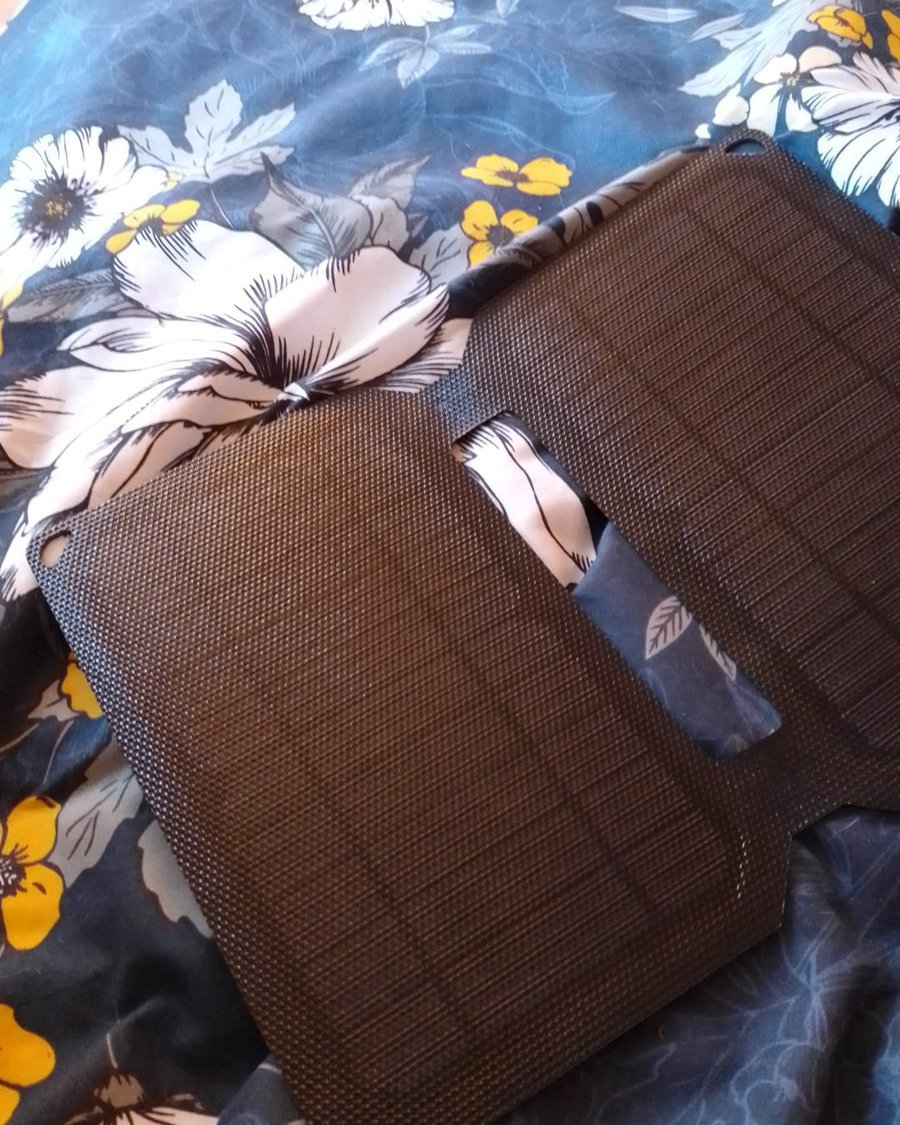
If you want solar charging that makes a real difference, a separate panel is the better route. A foldable panel in the 20 to 30 W class (an illustrative size) can, in good sun, deliver several times the watts of a built-in panel. Pair it with a regular 20,000 mAh USB-C power bank and you can refill the bank in a day or two of good sun rather than a week or more. The panel folds flat and clips to a pack, and it lets you keep the bank itself in the shade.
| Option | Best for | Solar charging reality | Watch out for |
|---|---|---|---|
| Solar power bank (built-in panel) | Emergency top-up, glovebox or day-pack backup | Very slow; a trickle in direct sun | Counting on the panel instead of charging at home first |
| Regular power bank + foldable panel | Camping trips and multi-day hikes | Much faster, depending on panel watts and sun | Extra weight, cables, and shade or cloud |
| Small portable power station | Outages, CPAP, a small fridge, laptops | Possible with a compatible panel; needs more panel watts | Weight, and airline limits (many are over 160 Wh) |
| Hand-crank/solar emergency radio | Weather alerts and news in an outage | Small panel or crank gives slow top-ups | Radio first, phone charging second |
For heavier needs, a power station is the better tool. Our guide to what a power station runs at camp and our walkthrough on reading a power station spec sheet will help you size one, and solar generators for home backup goes further. If you are planning for the cold, see how to stay warm in a power outage. For news and alerts, an emergency weather radio uses far less energy than a phone. And if you are building a kit, buying less outdoor gear keeps cost and clutter down.
A quick buying checklist
- Capacity in Wh: look for the Wh figure, not only mAh.
- USB-C PD: input and output, for faster charging both ways.
- Panel size or a separate panel: a bigger or foldable panel means more watts.
- IP rating: match it to how you will use it, and remember port covers must be closed.
- Weight: weigh it against how far you will carry it.
- Temperature range: check the operating and charging limits in the manual.
- Flight limit: 100 Wh or under for simple carry-on travel.
- Warranty: a clear warranty and a reachable support contact.
Products to look at
These are categories, not brand picks. Compare the features above.
- Solar power bank with USB-C PD: an emergency backup that is also a normal bank.
- Foldable solar panel for phones (USB): the more practical way to use the sun on a trip.
- Regular 20,000 mAh USB-C power bank: a flexible base for the panel above.
See solar power banks on Amazon (US)
See foldable solar panels on Amazon (US)
See 20,000 mAh power banks on Amazon (US)
Care tips and end of life
Many manufacturers recommend storing a power bank partly charged in a cool, dry place and topping it up every few months. Check your manual for its exact advice. Stop using a bank that swells, smells odd or gets unusually hot, and contact the maker.
When it is done, do not put it in household trash or recycling bins. The EPA says lithium-ion batteries should go to separate recycling or household hazardous waste collection points. The Call2Recycle locator (now part of The Battery Network) helps you find a drop-off by ZIP code. The EPA suggests putting each battery in its own plastic bag and taping over exposed terminals.
Confirmed vs. not
Confirmed (as of 18 November 2026):
- TSA: power banks go in carry-on bags, not checked bags (tsa.gov power banks page, last updated 14 May 2025).
- FAA PackSafe: spare lithium batteries of 100 Wh or less are allowed; 101 to 160 Wh need airline approval, two spares maximum; over 160 Wh are forbidden. Airlines may be stricter.
- EPA: lithium-ion batteries should not go in household garbage or recycling bins.
- IEC 60529 defines IP codes, with 6 meaning dust-tight and 7 meaning temporary immersion.
Estimates and our suggestions: the solar charging times, phone-charge counts, weights, the 65 percent efficiency assumption and the 20 to 30 W panel class are illustrative. Heat, storage and top-up habits vary by product, so follow your manual.
FAQ
Do solar power banks actually work?
Yes, but slowly. The small built-in panel is best treated as an emergency top-up. Charge the bank from a wall outlet before you go.
How long does a solar power bank take to charge in the sun?
In our illustrative example, a 10,000 mAh bank with a panel averaging about 1 W would need roughly 37 hours of good sun, so more than a week of real days. Your product and weather will differ.
Can I take a solar power bank on a plane?
Yes, in your carry-on only. Up to 100 Wh is generally allowed, 101 to 160 Wh needs airline approval with a limit of two, and over 160 Wh is not allowed. Airlines may have stricter rules, so check yours.
How many mAh do I need?
For about one to two phone charges, 10,000 mAh is a reasonable start. For a weekend away, 20,000 mAh covers roughly three charges by our estimate. These are rough numbers, since conversion losses vary.
Is a foldable solar panel better than a solar power bank?
For real sun charging, usually yes, because it has more panel area and so more watts. Pair it with a regular power bank. A built-in panel is mainly a backup.
How we wrote this
- Researched from official guidance (TSA, FAA, EPA) and standards information; FAA and TSA wording re-checked on 18 November 2026.
- Not hands-on tested. No brand paid for placement.
- Numbers we calculated are labeled as estimates.
Sources
- TSA: Power banks
- FAA PackSafe: Lithium batteries
- FAA: Airline passengers and batteries
- EPA: Used lithium-ion batteries
- The Battery Network (formerly Call2Recycle) drop-off locator
- IEC: IP ratings
Written by the Sunshine and Fresh Air team. Last checked: 18 November 2026.