
The Jackery Explorer 600 v2 is a mid-size portable power station that gets a lot of attention around the holidays. Before you buy, it helps to know what it can power and what it can’t. This is a spec-led explainer, not a review: we researched Jackery’s published specs and did not test the unit.
Quick answer: Jackery’s product page lists the Explorer 600 v2 at 640Wh with 500W of continuous output (1,000W surge). That suits phones, laptops, lights, a router and a 12V camping fridge for a day or more. It will not run anything over 500W continuously, such as a space heater, hair dryer, microwave or air conditioner, and it is not a full-size fridge solution.
Key specs in plain English
Jackery’s FAQ (updated August 2026) lists the model as JE-600A, with 640Wh of capacity, 500W of continuous AC output and 1,000W of instantaneous output. Here is what that means day to day.
- 640Wh (watt-hours) is the size of the “tank”. A 64W device would, in theory, run for ten hours.
- 500W continuous is the most the AC outlets can supply at once: 500W per port and 500W total across both, per the FAQ. If your devices add up to more, it will not run them.
- 1,000W surge covers the brief spike some motors draw at start-up. It is not a continuous rating.
- Battery: lithium iron phosphate (LiFePO4), rated by Jackery for 6,000 cycles to 70% of original capacity.
- Weight and size: around 6.4 kg (the product page says 14.11 lb), 31.1 x 20.5 x 15.7 cm. Light enough to carry to a campsite.
- Warranty: 3 years as standard, extendable by 2 years for a maximum of 5, per the FAQ.
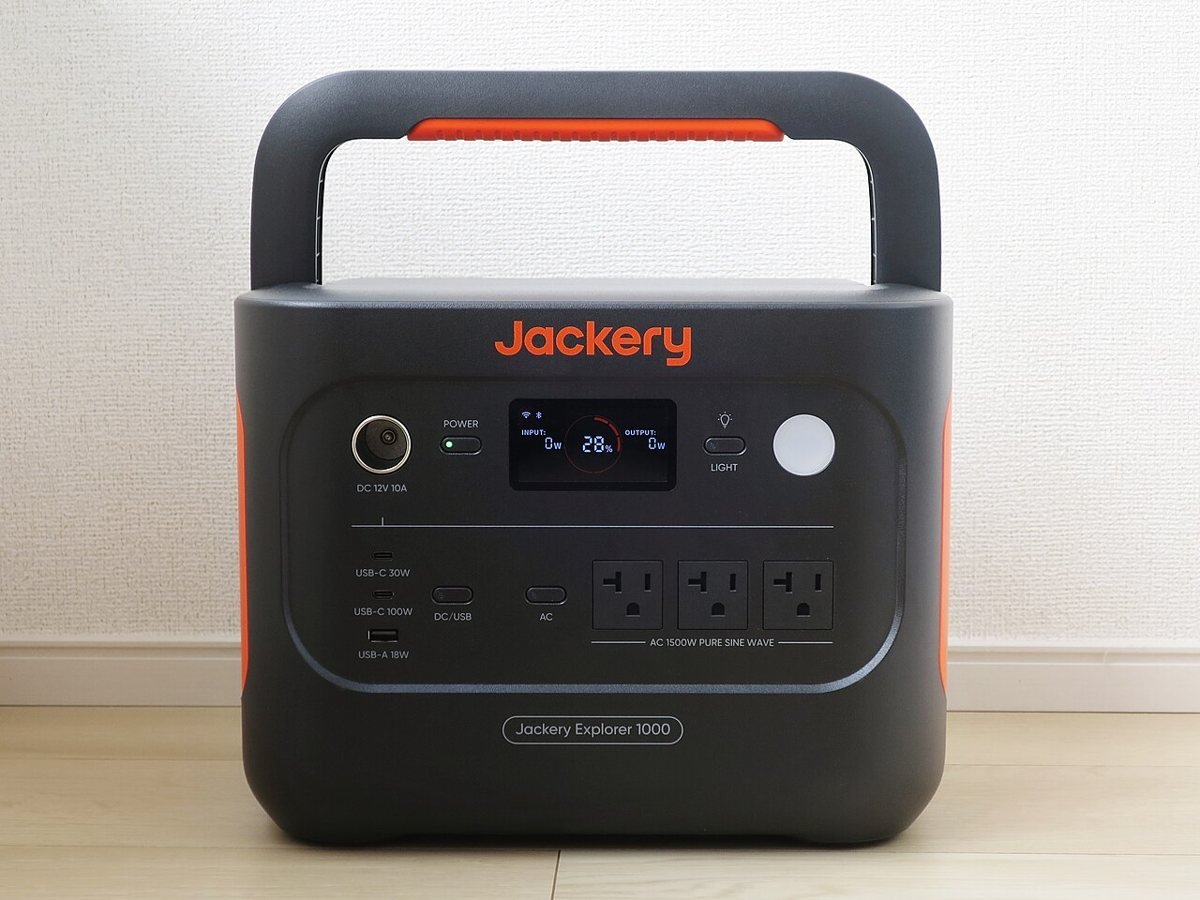
- Ports: two AC outlets, a 12V car port (10A), USB-A (up to 18W) and two USB-C outputs, one up to 100W and one up to 30W.
New to spec sheets? See our guide on how to read a power station spec sheet.
Runtime math you can do yourself
The formula is simple: battery watt-hours x about 0.85, divided by the device’s watts. The 0.85 is our own rough estimate for inverter and conversion losses, not a Jackery figure. For 640Wh, that gives about 544Wh of usable energy (640 x 0.85).
Results shift with temperature, battery age and inverter load, and using the USB or 12V ports directly often stretches runtime. Jackery’s FAQ also lists a standby power consumption of 12W. If that applies whenever the unit is on with nothing plugged in, 544Wh would be gone in about 45 hours of idling, so switch off the AC output when you do not need it.
| Device | Typical watts (typical; check your device label) | Rough runtime on 640Wh (544Wh usable) | Notes |
|---|---|---|---|
| Phone charging | 10-20W | About 27-54 hours of charging | Use a USB port, not the AC outlet, where you can. |
| Laptop | 45-65W | About 8-12 hours | Gaming laptops draw far more. |
| Router and modem | 10-20W combined | About 27-54 hours | Handy during a short outage; the 12W standby draw adds to it if the AC output stays on. |
| LED string lights | 5-20W | About 27-100 hours | LED only; older incandescent strings use much more. |
| 12V camping fridge | 40-60W while running, about 30-50% duty | Roughly 1-2 days on the 12V port; less through AC | Pre-chill food and keep the fridge shaded. |
| Space heater | 750-1,500W | Cannot run | Over the 500W limit. |
| Hair dryer | 1,000-1,800W | Cannot run | Over the 500W limit. |
For medical devices such as sleep apnea machines, check your device maker’s backup power guidance first.
What it cannot run
Anything over 500W continuous is out: space heaters, hair dryers, microwaves, toasters, kettles and air conditioners. A full-size refrigerator may start on the surge allowance but would drain the battery in a fraction of a day. Our refrigerator watts guide explains why.

Charging it
Wall charging. Jackery’s FAQ gives around 1.7 hours from an AC outlet (up to 550W input). The product page also quotes a 70-minute hybrid charge that uses more than one input.
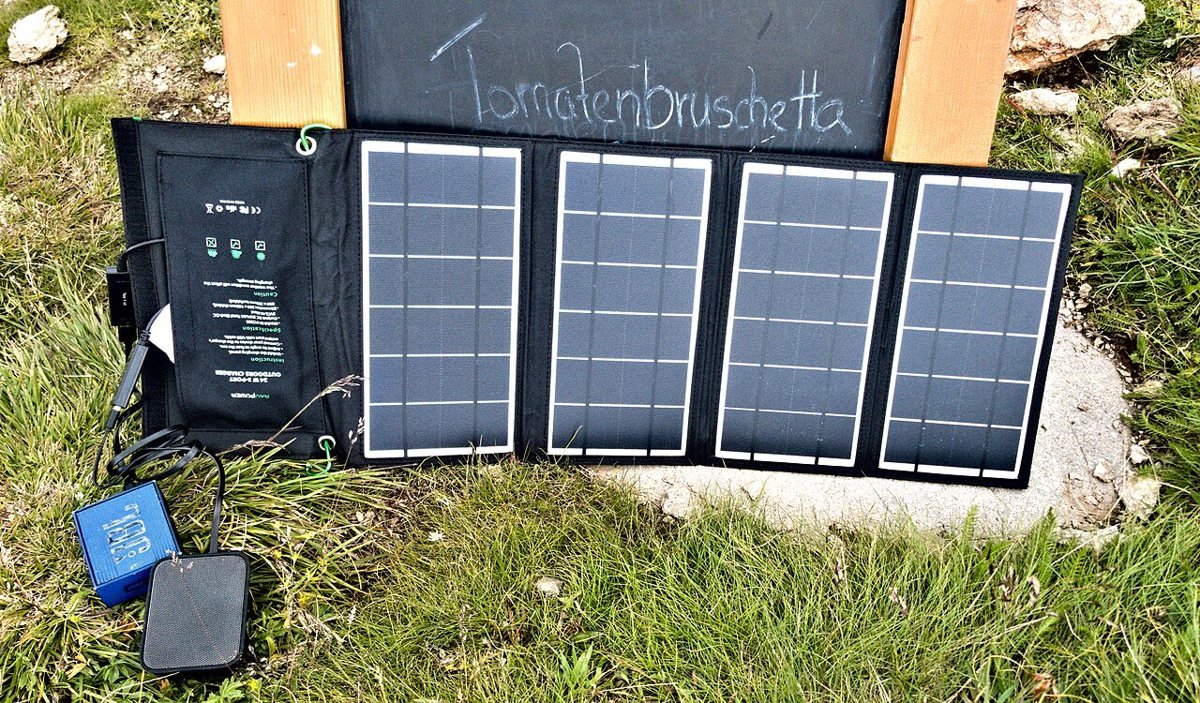
Solar. The FAQ lists a solar input of 16-60V, 10.5A, 200W maximum. Jackery’s charging times: one SolarSaga 40 about 20 hours (two, 11); one SolarSaga 80 about 11 hours (two, 5.5); one SolarSaga 100 about 8.5 hours (two, 4.3); one SolarSaga 200 about 4.3 hours.
One panel needs no accessories. Two panels need a SolarSaga adapter, and two is the maximum. Panels rarely hit their rated output (sun angle, clouds, shade and heat all cut into it), so plan for less.
Car. The unit charges from a 12V car outlet (11-16V, 8A max), slower than the wall. Jackery’s FAQ says about 3.8 hours; the product page quotes 7.5 hours. The FAQ also says USB-C input is not supported, so a USB-C wall charger will not work.
For a bigger picture on pairing panels with a battery, see our solar generator home backup guide.
Camping, road trips and home outages
This is where the 600 v2 fits best. At about 6.4 kg it is easy to carry, it makes no fumes and Jackery’s FAQ lists fan noise of 30dB or less. For a weekend tent trip, phones, lights, a fan and a 12V fridge are realistic. Our camping power guide covers the general rules.
For a short home outage, think small: router, modem, phones, a laptop, a lamp. Keep the 12W standby draw in mind if the outage is long, and turn off outputs you are not using.
The switchover caveat. Jackery’s FAQ says it switches to battery within 20 ms and is not a 0 ms, no-interruption UPS (the product page quotes 0.01 seconds). It warns against connecting devices that need a true uninterruptible supply, such as data servers or workstations.
One safety note: power stations produce no exhaust, but a gas generator must stay outdoors. The CDC says to only use generators outside, more than 20 feet away from any windows, doors, and vents.
Who should size up or down
Size down to the Jackery Explorer 300 Plus (or its newer 300 v2, which Jackery now points to) if you mostly charge phones and a laptop. Jackery’s FAQ lists the 300 Plus at 288Wh, 300W and about 3.75 kg, with USB-C charging, which the 600 v2 lacks.
Size up to the Jackery Explorer 1000 v2 if you want longer fridge runtime or more output. Its FAQ lists 1,070Wh, 1,500W, about 10.8 kg (23.8 lb) and up to 400W of solar input. Weighing brands? Our EcoFlow vs Jackery comparison may help.
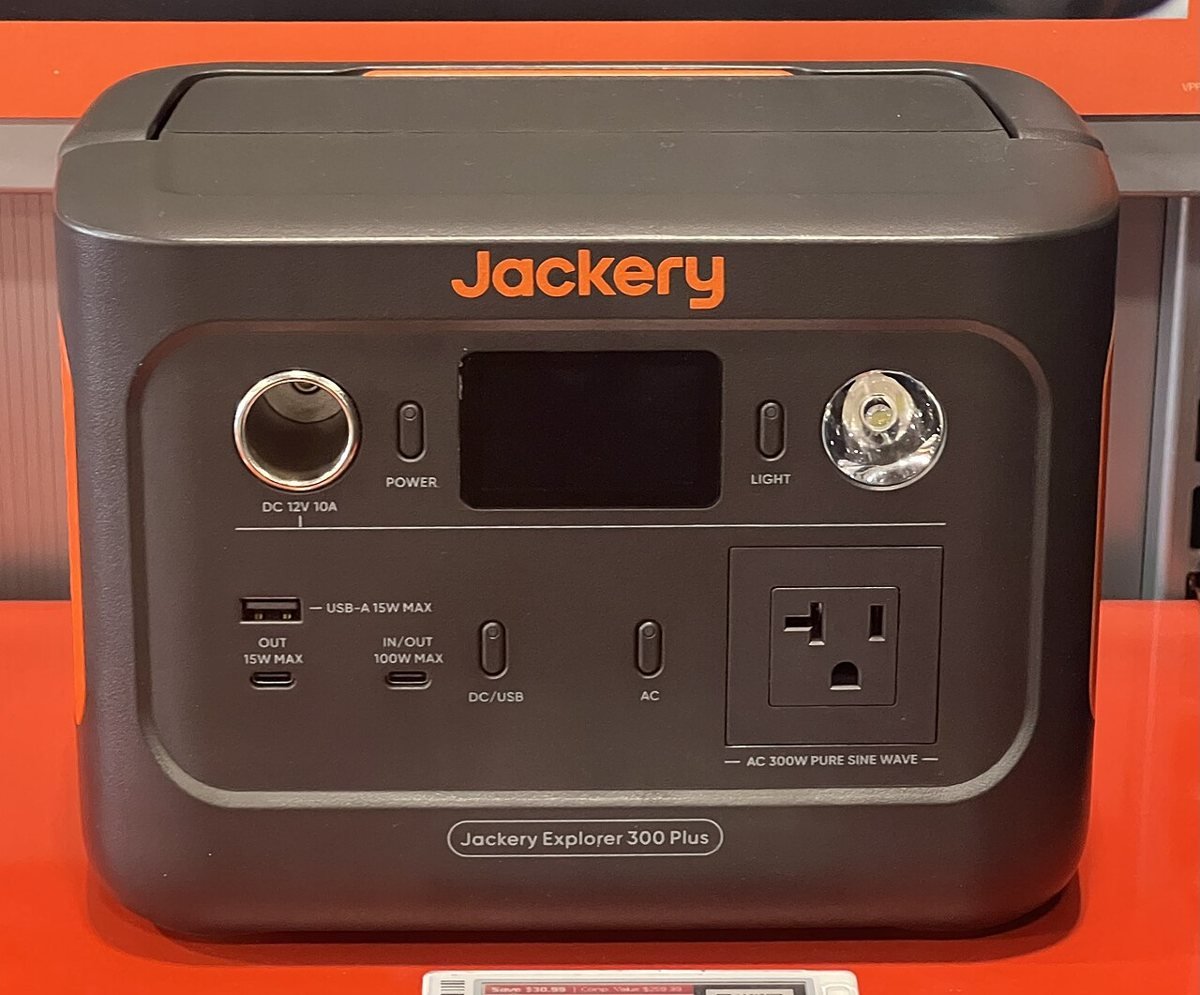
The top photo shows the bigger Explorer 1000 v2 and the lower one the Explorer 300 Plus, not the 600 v2.
A long-life LiFePO4 battery can serve you for years and replaces fuel and fumes at a campsite. We make no claim that it is greener overall; the best choice is the one you will actually use.
Where to look
See Jackery Explorer 600 v2 on Amazon (US)
See Jackery SolarSaga 100W panel on Amazon (US)
See Jackery Explorer 300 Plus on Amazon (US)
See Jackery Explorer 1000 v2 on Amazon (US)
Care tips
- Jackery’s FAQ storage guidance: 32-77F for up to one year, 32-113F for three months, -4 to 113F for one month.
- Keep the vents clear, and never leave it in a hot car or direct summer sun.
- Operating range is -4F to 113F; cold weather reduces usable runtime.
- Top it up every few months if it sits unused.
Confirmed vs. not
Confirmed (Jackery’s FAQ, updated August 2026, and Jackery’s product page, checked 12 November 2026): the specs, charging times, solar limits, temperature ranges, warranty and switchover wording above. The 100Wh limit comes from the FAA PackSafe page.
Not confirmed by us: real-world runtimes, current stock, holiday deals and whether the unit is available on Amazon. Jackery’s pages differ on car charging time and switchover speed, as noted.
FAQ
Can the Jackery Explorer 600 v2 run a refrigerator?
A 12V camping fridge, yes, often for a day or more. A full-size fridge will drain the battery quickly and is not a long-term fit.
How long does it take to charge?
Jackery’s FAQ says about 1.7 hours from a wall outlet and about 3.8 hours from a car.
Can it charge from solar, and how many panels?
Yes, up to 200W: one or two panels, with two needing a SolarSaga adapter.
Is it a UPS?
It switches to battery within 20 ms per Jackery’s FAQ, but it is not a true zero-gap UPS. Jackery says not to use it for data servers or workstations.
Can I use it indoors or take it on a plane?
It makes no fumes, so it can be used indoors. On a plane, no: the FAA limits lithium-ion batteries to 100Wh each (101-160Wh with airline approval), so 640Wh is far above the limit.
How we wrote this
- We researched published specs. We did not test the unit.
- Features are quoted as Jackery states them, with differences noted.
- No brand paid for this article.
Sources
- Jackery Explorer 600 v2 product page
- Jackery FAQ: Explorer 600 v2 Basic Information
- Jackery FAQ: Explorer 1000 v2 Basic Information
- Jackery FAQ: Explorer 300 Plus Basic Information
- FAA PackSafe: Lithium Batteries
- CDC: Carbon Monoxide Poisoning Basics
Written by the Sunshine and Fresh Air team. Last checked: 13 November 2026.